Which Hoka Shoe Is Best For Me – Buying Guide And Recommendations
To find the best Hoka shoe for you, consider your running style, foot shape, and terrain. Choose maximal cushioning like Bondi or Mafate X for long distances or trails. On the other hand, Clifton or Rincon suits road running with moderate cushioning.
Speed-focused runners benefit from Mach 7 or Tecton X 3’s lightweight, responsive design. If you overpronate, look for models with stability features like H-Frame or J-Frame.
Explore further to compare cushioning levels, support, and specific trail or walking options. That way, you can pick the perfect shoe that fits your needs.
Key Takeaways
- Choose Hoka shoes based on your running style, terrain, and goals, such as Speedgoat for trails or Clifton for road running.
- Match shoe fit to your foot shape: wide feet need roomy toe boxes, narrow feet require snug fits, and high arches need extra support.
- Select cushioning levels according to activity, with maximal cushioning for long runs and firmer midsoles for speed and responsiveness.
- Opt for stability features like H-Frame or J-Frame if you overpronate to improve support and reduce injury risk.
- Consider walking shoes for maximum cushioning and stability, while running shoes prioritize lightweight design and responsive midsoles.
How to Choose the Right Hoka Shoe for Your Running Style and Goals
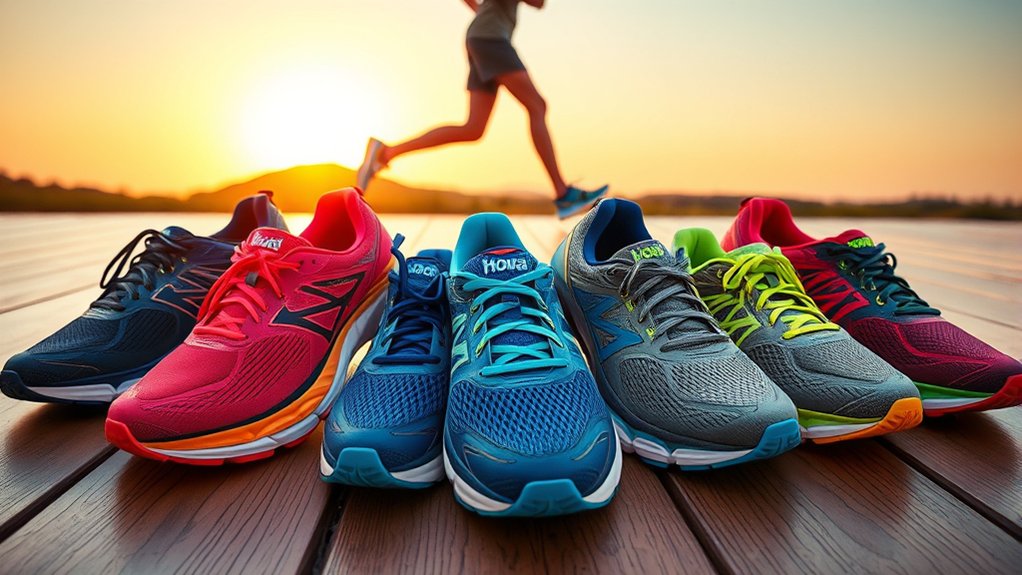
When choosing the right Hoka shoe for your running style and goals, you’ll need to take into account several key factors that influence comfort and performance.
Start by identifying your running style: heel, midfoot, or forefoot striker. Then match the shoe’s cushioning accordingly: maximal for long runs, moderate for daily training, or firmer for speedwork.
Consider stability features like the H-Frame or J-Frame if you need extra support for overpronation.
Terrain matters too. You’ll want to select trail-specific models like the Speedgoat or road-focused shoes like the Clifton.
While these functional aspects dominate, shoe color options and brand collaborations add a personal touch. They offer styles that suit your preferences without compromising performance.
This balance guarantees you pick the ideal Hoka shoe tailored to your unique running needs.
Key Factors to Consider: Fit, Foot Shape, and Cushioning Preferences
When you’re choosing your Hoka shoes, think about your foot shape—whether it’s narrow, wide, or if you tend to overpronate—because that really affects how the shoe fits and how stable it feels. It’s a good idea to check out the toe box widths and the internal volume in different models to make sure they’ll be comfortable no matter what activity you’re doing.
Also, take some time to consider your cushioning preferences. Do you want maximum shock absorption, or do you prefer a firmer midsole that gives you more responsiveness? Finding the right balance can make a big difference in how your shoes feel on your feet.
Foot Shape Variations
How do you guarantee your Hoka shoes truly match your unique foot shape? Start by examining key fit elements like arch support and toe box width to ensure comfort and functionality.
Different foot shapes need specific considerations for optimal performance. For example, wide feet require a roomier toe box width to prevent pinching and allow natural expansion. Narrow feet benefit from a tapered toe box and snug internal volume to avoid slipping.
High arches often need enhanced arch support to maintain stability and reduce strain. Flat feet may require shoes with structured support to control overpronation. Proper internal shoe shape also prevents pressure points and blisters during activity.
Choosing Hoka shoes that align with your foot shape enhances comfort, reduces injury risk, and improves overall support. So, take the time to find the right fit—it really makes a difference!
Cushioning Level Choices
Although cushioning preferences vary widely among runners, selecting the right level in your Hoka shoes depends heavily on your foot shape and fit requirements. Cushioning materials and heel height directly influence shock absorption and comfort. Stack heights range from moderate (around 30mm) to maximum (up to 40mm).
If you have wider feet, choosing a model with a spacious toe box and stable platform helps accommodate increased cushioning without compromising fit.
Align cushioning levels with your running style. Maximum cushioning suits long distances by reducing impact, while firmer midsoles offer responsiveness for speed and agility.
Matching cushioning to your foot’s arch height and shape ensures proper pressure distribution, preventing discomfort and injury.
Fit and Comfort
Why does fit matter so much in choosing your Hoka shoes? Proper fit guarantees comfort, prevents injuries, and maximizes performance by matching shoe sizing and shape to your foot’s unique structure.
When selecting your ideal pair, consider these key factors:
Toe box width: some Hokas have tapered shapes, others wider for natural toe splay.
Arch support features like J-Frame or H-Frame help control overpronation.
Cushioning preferences vary too, from plush Bondi models to firmer Mach 7 options.
Make sure the fit is secure without creating pressure points to avoid blisters and discomfort.
Also, think about foot shape compatibility — matching the shoe contour to your foot’s dimensions is super important.
Getting the right fit means you’ll feel great and perform your best.
Which Hoka Shoes Offer the Most Cushioning and Comfort?
If you’re looking for maximum cushioning, the Bondi 9 is a great choice. It features a 41.3/32.2 mm stack height and offers top-notch shock absorption, making it super comfortable for long distances.
Then, there are the Mafate X and Clifton 10, which come with plush midsoles that really help absorb impact. They’re designed to handle different terrains and mileage, so they’re perfect if you want something versatile.
Now, if you’re after a mix of cushioning and stability, the Arahi 8 is worth checking out. Its dual-density foam gives you that soft, comfy feel while also providing extra control.
Maximum Cushioning Models
When seeking maximum cushioning and comfort, Hoka offers several models that excel in shock absorption and plush support. Their advanced cushioning technology features thick midsoles and high stack heights. This ensures outstanding impact protection without making the shoes too heavy.
Here are top picks for maximum cushioning:
- Hoka Bondi 9: 41.3/32.2 mm stack height, highest shock scores for heel and forefoot.
- Hoka Mafate X: 49 mm heel with PEBA core midsole, designed for ultrarunning comfort.
- Hoka Bondi 8: Plush maximalist cushioning ideal for recovery and long-distance.
- Hoka Clifton 10: 44.4/32.0 mm stack height, balances cushioning with stability.
- Maximal Cushioning Series: Prioritizes shock absorption to reduce foot impact.
These models offer plush comfort while keeping shoe weight manageable for extended wear. So, you can enjoy cushiony support without feeling weighed down.
Plush Comfort Features
What makes certain Hoka models stand out for plush comfort is their expert combination of thick midsoles and innovative foam technologies like EVA and PEBA. You’ll find maximalist shoes such as the Bondi series and Mafate X feature up to 49mm heel height, delivering cloud-like cushioning ideal for long walks or trail runs.
The Clifton 10 adds comfort with an extended toe box and increased heel stack. When choosing, consider shoe maintenance to keep cushioning intact and note fashion trends, as these models blend comfort with style.
| Model | Midsole Height | Foam Technology |
|---|---|---|
| Bondi 8/9 | 33-35mm | EVA |
| Mafate X | Up to 49mm | EVA + PEBA |
| Clifton 10 | Moderate | EVA |
What Are the Best Hoka Models for Speed and Lightweight Performance?
Although many Hoka models offer comfort and support, the Mach 7 and Tecton X 3 really stand out for speed and lightweight performance.
The Mach 7 weighs just 7.9 oz (224g) and features a responsive PEBA foam midsole with a carbon plate. This combo delivers a firm, energetic ride.
The Tecton X 3 uses similar materials but adds enhanced stability, making it ideal for racing and speed training.
Both shoes have breathable uppers and durable construction, so you get comfort and longevity.
Key features to consider:
- Lightweight PEBA foam midsoles for quick acceleration
- Carbon plates for responsive propulsion
- Breathable creel jacquard upper enhancing comfort
- Notched gusseted tongue improving fit stability
- Multiple color options paired with material durability
If you want speed without giving up support or durability, these models are definitely worth checking out.
How Do Hoka Shoes Provide Stability and Support for Overpronators?
Because overpronation can lead to discomfort and injury, Hoka designs specific stability features that actively counteract excessive inward foot rolling. They use the H-Frame or J-Frame Stability System to provide firmer arch support and enhance heel stability. Wide bases and dual-density foams stabilize your foot, preventing inward collapse during gait.
Padded heel counters and a secure fit minimize heel movement, promoting a balanced stride.
| Feature | Function | Benefit for Overpronators |
|---|---|---|
| H-Frame/J-Frame | Arch support structure | Controls excessive foot rolling |
| Dual-density foam | Midsole cushioning | Enhances torsional rigidity |
| Wide base | Foot stabilization | Promotes proper alignment |
| Padded heel counter | Heel stability | Minimizes heel movement |
These combined elements guarantee you get reliable support and stability. It’s all designed to keep your feet feeling balanced and comfortable every step of the way.
Best Hoka Shoes for Trail Running and Rough Terrain
Where should you turn when you need a shoe that excels on rugged trails and unpredictable terrain? Hoka’s trail options, like the Speedgoat 7 and Mafate X, offer outstanding trail shoe durability and gaiter compatibility, making them top choices for tough conditions.
The Speedgoat 7 features 5mm lugs and a protective midsole, ideal for mixed terrain.
The Mafate X provides maximum cushioning and a wide toe box for ultrarunning comfort.
Consider these key features: aggressive outsole patterns for superior traction, reinforced uppers to resist abrasion, and durable rubber soles built for rough paths.
They also come with gaiter attachment points to keep debris out, plus responsive midsoles that balance protection and comfort.
Choosing between these depends on whether you prioritize cushioning or nimble protection on rough terrain.
Comparing Hoka’s Max Cushioning Models for Long Distance and Recovery
When you need maximum cushioning for long-distance runs or recovery days, Hoka’s Bondi series and Mafate X models really stand out with their ultra-thick midsoles and advanced shock absorption technologies.
For ultimate cushioning on long runs or recovery, Hoka’s Bondi and Mafate X deliver unmatched comfort and shock absorption.
The Bondi 9 features a 41.3mm heel stack height and a shock absorption score of 146 SA. This delivers plush cushioning that’s ideal for high-mileage road training, and it keeps the shoe’s weight moderate.
On the other hand, the Mafate X offers even thicker midsoles, going up to 49mm stack height, plus a wider toe box. It combines cushioning technology with durability, which is great for trail ultrarunners.
While both models focus on impact protection, the Mafate X adds sturdy rubber outsoles and supportive foam frames like H-Frame and J-Frame to boost stability on rugged terrain.
Budget-Friendly Hoka Shoes That Don’t Sacrifice Quality
If you’re looking for a Hoka shoe that balances quality and affordability, the Rincon 4 stands out as a top contender. Priced around $125 and often discounted to $100, it offers lightweight support and plush cushioning without compromising durability.
Compared to pricier models, it provides 3mm more cushioning than the Rincon 3, making it ideal for short, fast runs and daily training.
The Rincon 4 also aligns with current fashion trends by offering sleek, versatile designs. Plus, Hoka’s sustainability initiatives reflect in its use of durable materials, reducing frequent replacements.
- Dual-layer compression-molded EVA foam for comfort
- Rubberized outsole for stability and durability
- Lightweight yet supportive build
- Affordable price without cutting performance
- Stylish design fitting modern fashion trends
This shoe proves budget-friendly doesn’t mean low quality.
Key Differences When Choosing Hoka Shoes for Walking vs. Running
Although both walking and running shoes from Hoka prioritize comfort, they differ markedly in design to suit their specific activities. Walking shoes emphasize maximum cushioning, stability, and support, featuring plush midsoles and wide platforms for comfort over long distances.
Hoka walking shoes prioritize cushioning, stability, and support with plush midsoles and wide platforms for long-distance comfort.
In contrast, running shoes focus on responsiveness, lighter weight, and firmer midsoles to enhance energy return and speed.
Walking models offer forgiving toe boxes and lower heel-to-toe drops, while running versions use aggressive rocker profiles for efficient strides.
Understanding these distinctions helps you select the right shoe based on activity, aligning with Hoka’s brand history of innovation and performance.
While fashion trends influence aesthetics, prioritizing functional differences guarantees ideal comfort and performance whether you walk or run.
Frequently Asked Questions
How Do Hoka Shoes Compare to Other Running Shoe Brands?
You’ll find Hoka’s performance technology excels in cushioning and stability, setting it apart from competitors. Their brand reputation highlights plush comfort and innovative support, offering a unique, protective ride compared to traditional, lighter running shoe options.
When you slip on a pair of Hokas, the difference is clear. They focus on giving you a soft, cushioned experience without sacrificing stability. It’s like having extra support that still feels light on your feet.
Can Hoka Shoes Be Used for Casual Everyday Wear?
When Sarah swapped her sneakers for Hoka Bondis, she loved their comfort features and fashion versatility. You’ll appreciate their plush cushioning and stylish designs, making Hoka shoes ideal for casual everyday wear.
They offer great support without sacrificing flair. So, whether you’re running errands or meeting friends, Hokas can easily fit into your daily routine. Seriously, they’re that comfortable and cool!
What Is the Typical Lifespan of a Hoka Running Shoe?
You’ll find a typical Hoka running shoe lasts 300 to 500 miles before the cushioning starts to break down. This breakdown can affect your running performance quite a bit.
Rotating between pairs and keeping an eye on wear and tear can really help. It’s the best way to maintain ideal support and avoid injury risks. Staying on top of this makes a big difference!
Are Hoka Shoes Suitable for People With Wide Feet?
Yes, Hoka shoes offer wide foot comfort with roomy toe boxes and generous shoe sizing. Models like Gaviota 6 and Arahi 8 provide stability without tightness, making them excellent for broader feet compared to many competitors.
They really focus on giving your feet enough space to move comfortably. So, if you have wide feet, these shoes can be a great fit without feeling restrictive. Plus, the support they offer is solid, which is a big plus for everyday wear or running.
How Do I Properly Clean and Maintain My Hoka Shoes?
Think of shoe cleaning as tending a garden: gently brush dirt away, hand wash with mild soap, and air dry.
For sole maintenance, avoid harsh chemicals. Instead, choose sneaker cleaner or baking soda to keep your Hokas fresh and durable.
Conclusion
Choosing the perfect Hoka shoe isn’t just a walk in the park, it’s like finding the moon in your backyard. You’ll want to weigh fit, cushioning, and support against your running style and terrain.
Whether you crave max cushioning for long runs or a lightweight model for speed, Hoka has options that balance comfort and performance. Don’t forget to compare trail versus road shoes. Also, consider your budget without sacrificing quality.
Your ideal pair is out there, ready to elevate every step.