Are Mens And Womens Shoe Sizes The Same – Conversion Guide Explained
Men’s and women’s shoe sizes aren’t the same because of differences in foot anatomy, design, and sizing standards. Generally, women’s sizes run about 1.5 to 2 sizes smaller than men’s, but this can vary depending on the brand and region. Materials, shoe shape, and width also play a role in how a shoe fits.
To convert sizes accurately and avoid poor fit or having to return shoes, it’s a good idea to always check specific brand charts. Also, keep comfort factors in mind when choosing your size. Understanding these details will help you find the right size and style that works best for you.
Key Takeaways
- Men’s shoe sizes are generally 1.5 to 2 sizes larger than women’s sizes for the same foot length.
- Women’s shoes are typically narrower and shaped differently due to anatomical and fashion differences.
- Shoe size conversions vary by brand, region, and material, so always check specific sizing charts.
- Proper fit depends on shoe design, last shape, and material flexibility, not just numerical size conversion.
- Measuring feet accurately and trying shoes with usual socks improves fit when converting between men’s and women’s sizes.
How Men’s and Women’s Shoe Sizes Differ and Why
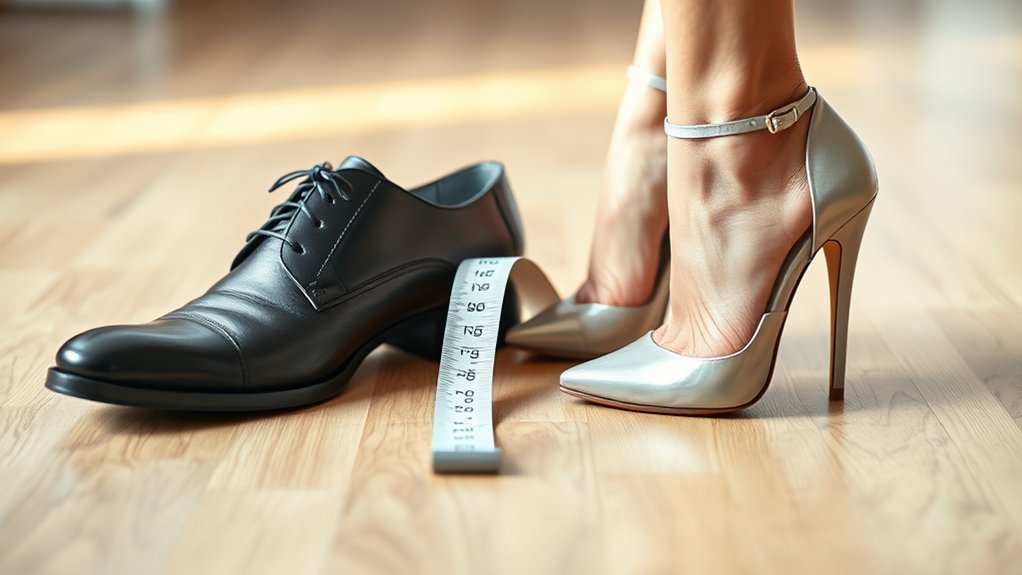
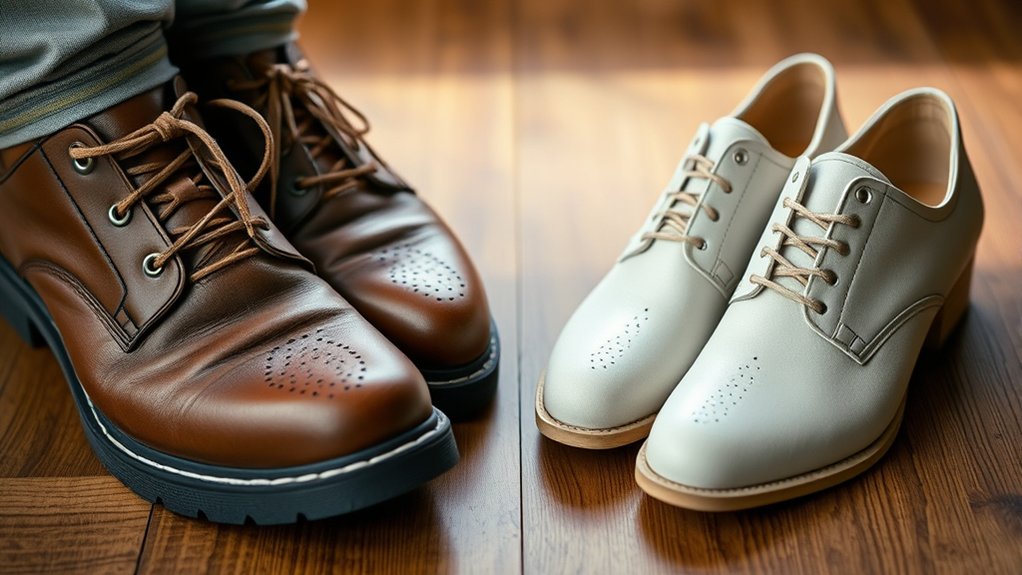
Although men’s and women’s shoe sizes might seem similar, they follow different measurement standards that can affect fit and comfort. You’ll find men’s sizes are typically based on a slightly larger foot length and width, reflecting anatomical differences.
Women’s shoes often run narrower, influenced by fashion trends that emphasize sleek, streamlined designs.
Additionally, shoe material plays a vital role. Flexible materials in women’s shoes can accommodate narrower fits, whereas sturdier materials in men’s shoes support broader foot structures.
These factors impact not only comfort but also performance and durability.
Understanding these distinctions guarantees you select shoes that align with both anatomical needs and style preferences. Recognizing how measurement variations correspond to shoe material and fashion trends helps you make informed choices for ideal fit and function.
How to Convert Men’s Shoe Sizes to Women’s
Converting men’s shoe sizes to women’s requires understanding the standard size difference, which is typically 1.5 to 2 sizes smaller in women’s measurements. To convert accurately, subtract 1.5 or 2 from the men’s size to find the equivalent women’s size.
Keep in mind that shoe material plays a role in fit. Flexible materials may accommodate slight size variations better than rigid ones.
Additionally, consider the foot arch, as men’s and women’s shoes often differ in arch support design, affecting comfort and fit. When converting, verify the chosen women’s shoe supports your foot arch appropriately to avoid discomfort.
Precise sizing combined with attention to shoe material and arch support ensures the best fit and performance. It’s worth taking the time to get it right!
How to Convert Women’s Shoe Sizes to Men’s
To convert women’s shoe sizes to men’s, you’ll want to keep in mind that men’s sizes are generally about 1.5 to 2 sizes smaller than women’s.
It’s a good idea to use a reliable conversion chart to make sure you get the right fit. That way, you won’t have to guess and can find the perfect size more easily.
Size Difference Explained
When you need to switch between women’s and men’s shoe sizes, understanding the size difference is essential for an accurate fit.
Historically, shoe size history shows that gender-specific footwear evolved due to anatomical differences between men and women, leading to distinct sizing systems.
Typically, men’s sizes run about 1.5 to 2 sizes smaller than women’s for the same foot length. For example, a women’s size 8 generally corresponds to a men’s size 6.5 or 7.
This discrepancy arises because women’s sizes often start higher on the scale to accommodate narrower feet, while men’s sizes reflect broader dimensions.
Knowing this size difference helps you convert accurately without trial and error.
That way, you can ensure comfort and a proper fit when transitioning between men’s and women’s shoe sizes.
Conversion Chart Usage
Understanding the size difference between men’s and women’s shoes sets the foundation for using a conversion chart effectively.
When converting women’s shoe sizes to men’s, you’ll typically subtract 1.5 to 2 sizes to maintain proper shoe fit and sizing accuracy. For instance, if you wear a women’s size 8, your equivalent men’s size would be approximately 6.5 or 6.
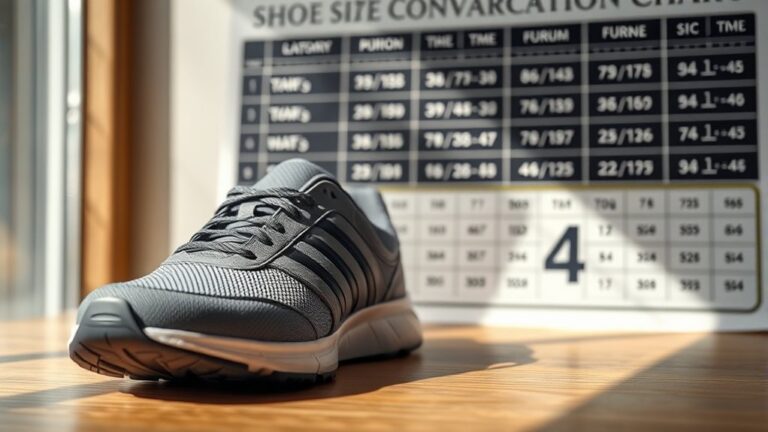
Using a conversion chart guarantees you select the correct size without guesswork, minimizing discomfort and fit issues. Always check the specific brand’s chart, as sizing can vary slightly.
It’s a good idea to prioritize measurements like foot length and width alongside the chart to enhance sizing accuracy.
This method guarantees a precise fit, which is essential for comfort and foot health when switching between men’s and women’s shoe sizes.
Factors That Affect Shoe Size Conversion Accuracy
You need to keep brand variations in mind because sizing can differ quite a bit between manufacturers.
Also, measurement standards aren’t the same everywhere, which means sizes don’t always translate perfectly across regions.
Brand Variations Impact
Although shoe size charts offer standardized measurements, brand variations can really affect how accurate those conversions are. You’ve got to keep in mind that each brand might interpret sizing standards in its own way. This can impact both brand consistency and how true the sizing really is.
So, even if you know your size in one brand, it mightn’t line up perfectly with another. There are a few factors that play into this. For example, differences in last shape and shoe construction can make a big difference.
Then, there’s regional manufacturing processes and the materials used. Brands also consider the foot shapes typical of their target markets.
Plus, quality control measures can vary from brand to brand, adding another layer of variability.
Measurement Standards Differences
Three primary measurement standards, US, UK, and EU, serve as the foundation for shoe sizing, but discrepancies between them can make accurate size conversions tricky. Each system uses different length increments and starting points. So, a direct size match doesn’t always mean it’s going to fit perfectly.
On top of that, things like the shoe material and the width of your foot also affect sizing accuracy. Stiffer materials or wider feet might need adjustments beyond the usual conversions.
| Standard | Unit Length (mm) | Typical Increment (mm) |
|---|---|---|
| US | 8.47 | 4.23 |
| UK | 8.47 | 4.23 |
| EU | 6.67 | 6.67 |
Knowing these measurement details helps you better understand size charts. That way, you can pick the right shoes even with the usual conversion challenges.
Tips for Choosing Men’s and Women’s Shoe Sizes Online
When shopping for shoes online, understanding the nuances of sizing charts can really boost your chances of picking the right fit. Men’s and women’s shoe sizes often differ because of various measurement standards and how flexible the shoe materials are.
To make the best choice, here are some tips to keep in mind: Verify the specific sizing chart for the brand and gender category since fashion trends can influence sizing norms. Measure your foot length and width carefully, and think about whether the shoe material will stretch or stay rigid.
Also, check out customer reviews that focus on how accurate the fit is and how the material performs in real life. Don’t forget to look at the return policies before you buy, especially if you’re converting between men’s and women’s sizes.
Using these strategies will help you deal with sizing complexities and make sure you get a comfortable, precise fit that matches current fashion trends and material qualities.
How Major Brands Handle Men’s vs. Women’s Sizing
Since sizing standards vary widely, major brands develop their own systems to differentiate men’s and women’s shoe sizes. You’ll notice that brands often adjust length and width measurements to reflect anatomical differences, with women’s shoes typically narrower. These adjustments consider fashion trends, influencing silhouette and fit preferences seasonally.
Also, shoe material impacts sizing. Flexible materials like knit fabrics may offer more stretch, while rigid leather demands precise measurements.
When you shop, brands may label women’s sizes separately or provide a conversion chart, but sizing can still differ.
Understanding how each brand aligns their sizing with foot morphology and material properties helps you select the correct size. Paying attention to these details ensures you find shoes that fit comfortably and complement current fashion trends.
It’s all about finding the right fit and style that works for you.
What to Do When Your Converted Shoe Size Doesn’t Fit
Even if you carefully convert your shoe size, there’s a chance the fit won’t be perfect because different brands have their own standards and everyone’s feet are shaped differently.
Shoe sizes vary by brand and foot shape, so a perfect fit isn’t always guaranteed.
When your converted size doesn’t fit, the best thing to do is focus on getting an accurate shoe fit by checking your foot measurement again. Here are some steps to try.
Re-measure your feet at the end of the day since feet tend to swell naturally.
Also, try the shoes on with the socks or insoles you usually wear to get a more realistic idea of the fit.
It’s a good idea to test different brands because the shape of the shoe, or the last, can change how it fits even if the size label is the same.
You might also want to consider going up or down by half or a full size, especially when switching between men’s and women’s sizes.
Why Knowing Shoe Size Conversion Saves You Time and Money
Accurately converting shoe sizes helps you avoid the common pitfalls of incorrect fit. This saves you from costly returns and exchanges. When you understand size conversion, you can confidently shop for shoes across different regions and genders.
You’ll also factor in variations caused by fashion trends or shoe materials. This knowledge reduces guesswork, making sure your purchase matches your expectations.
| Region | Men’s Size | Women’s Size |
|---|---|---|
| US | 9 | 10.5 |
| UK | 8 | 8.5 |
| EU | 42 | 41 |
| Japan | 27 | 26.5 |
| Australia | 8.5 | 9.5 |
Common Mistakes to Avoid When Buying Shoes Across Genders
When purchasing shoes across genders, you need to be aware of size discrepancies and design differences that can affect fit and comfort. Men’s and women’s shoes often vary not just in size but also in material, which impacts shoe durability and performance.
Avoid these common mistakes: assuming a direct size conversion without checking brand-specific charts, overlooking width variations that influence comfort and support, ignoring material differences that affect shoe durability and flexibility, and disregarding the structural design tailored to gender-specific foot anatomy.
It’s easy to overlook these details, but paying attention can make a big difference in how your shoes feel and last. So, take a little extra time to check those size charts and consider the design before buying. You’ll thank yourself later!
Frequently Asked Questions
Are Kids’ Shoe Sizes Converted Differently Than Adults’ Sizes?
Yes, kids’ shoe sizes use different children’s sizing differences compared to adult size conversions. You’ll find that children’s sizes are generally numerical and don’t directly align with adult scales.
Because of this, you need specific charts for accurate conversion between the two. It’s not just a simple number swap. Kids’ sizing follows its own system, which makes sense given how quickly their feet grow.
Do Width Measurements Differ Between Men’s and Women’s Shoes?
Yes, shoe width differs between men’s and women’s shoes due to anatomical variations. You’ll notice size consistency challenges because men’s shoes generally have wider widths. So, you should always check specific width measurements before purchasing.
How Do International Shoe Size Systems Compare to US Sizes?
You’ll find international shoe size systems vary considerably from US sizes due to differing shoe manufacturing standards. This affects size consistency quite a bit.
Can Orthotic Insoles Affect Shoe Size Choice?
Yes, orthotic insoles impact orthotic fit and size accuracy. You’ll need slightly larger shoes or adjustments to guarantee comfort and proper support. This helps avoid compromising your foot’s alignment or shoe performance when using insoles.
It’s all about making sure your feet feel good and your shoes work well with the added support. So, don’t be surprised if your usual shoe size feels a bit snug once you add orthotic insoles. A little extra room goes a long way!
Are There Specific Shoe Types That Don’T Follow Standard Size Conversions?
Yes, you’ll find unisex sizing often bypasses standard conversions, especially in shoes with varying material differences affecting fit.
Synthetic or stretch fabrics may require adjustments beyond typical size charts to guarantee proper comfort and support. It’s not always one-size-fits-all when it comes to these types of shoes. So, it’s a good idea to try them on or check specific brand guidelines before buying.
Conclusion
Finding shoe sizes between men’s and women’s is like decoding a map with shifting scales. Precision really matters to find your true fit. By understanding conversion nuances and brand variations, you avoid the pitfalls of guesswork. This saves you time and money.
Think of your correct shoe size as a key that opens comfort and performance. When conversions falter, rely on measured adjustments rather than assumptions. That way, every step feels just right.