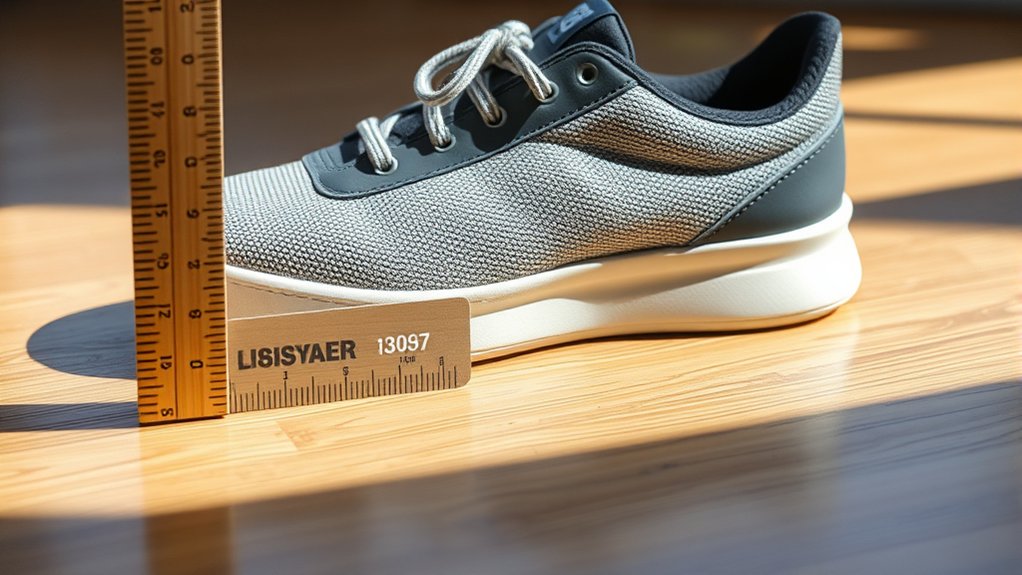
Are Shoe Sizes In Inches – Measurement System Explained
You measure your foot length in inches, but shoe sizes don’t directly match these measurements because of different sizing systems like US, UK, EU, and Mondopoint. Each system starts from its own baseline and uses standardized increments instead of exact foot lengths.
Sizes also vary by gender and shoe width standards, which can affect how a shoe fits. Knowing how to convert inches accurately and understanding width codes can really help improve comfort.
Once you get the hang of these details, it becomes much clearer how shoe sizes actually work. It’s not just about the length of your foot but also how all these factors come together.
Key Takeaways
- Shoe sizes are not measured directly in inches but based on standardized intervals related to foot length.
- US shoe sizes increase by about 1/3 inch per full size, starting near 8⅓ inches for men’s sizes.
- UK sizes use barleycorn units, starting at 7⅔ inches for size 1, with size increments roughly one-third inch.
- European sizes convert foot length from centimeters, increasing by 0.75 cm per size, not by inches.
- The Mondopoint system uses direct millimeter measurements for length and width, avoiding inches entirely.
How to Measure Your Foot Length in Inches
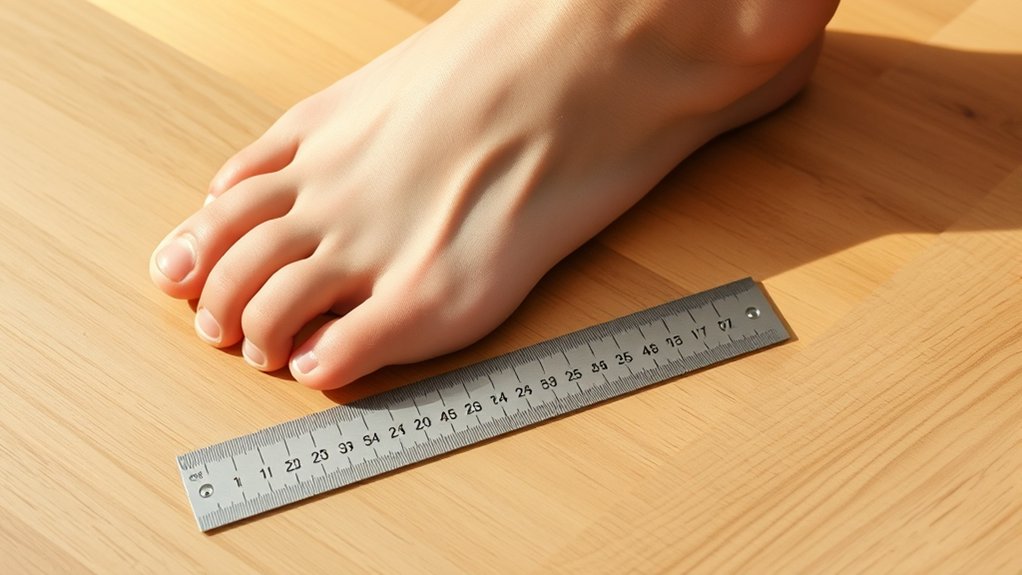
When measuring your foot length in inches, start by placing your foot flat on a piece of paper. Mark the tip of your longest toe and the heel contact point. Then, use a ruler or measuring tape to determine the exact distance between these marks.
Make sure to measure both feet because one foot may be slightly longer than the other. Always use the larger measurement for shoe sizing.
Measure both feet and use the larger size to ensure the best shoe fit and comfort.
It’s also important to stand with your weight evenly distributed to account for foot expansion during weight-bearing.
Try to do this measurement at the end of the day since feet tend to swell. Getting an accurate foot length measurement directly impacts your choice of shoe material and the comfort of your insoles.
When your shoes fit properly, it prevents material distortion and helps insoles support your foot correctly, which means better comfort and durability overall.
Why Shoe Sizes Don’t Match Foot Length Exactly
Although you might expect shoe sizes to match your foot length exactly, they actually don’t. Instead, shoe sizes are based on standardized measurement intervals rather than your precise foot dimensions. Because of this, there can be a difference between the labeled size and the length of your actual foot.
There are a few reasons for this mismatch. First, size increments are standardized—like half or full sizes—and these often cover more than just small changes in foot length. Plus, shoe padding is added on purpose for comfort, which changes the inside dimensions of the shoe.
Another factor is the last shape, which is the mold used to make the shoe. This shape varies depending on the manufacturer and affects how the shoe fits. Also, different regions use different sizing systems with their own units and intervals, which adds to the inconsistency.
Common Shoe Size Systems: US, UK, EU, and Mondopoint Explained
Understanding why shoe sizes don’t match foot length exactly helps clarify the need for different sizing systems worldwide. The US system uses numerical sizes increasing roughly 1/3 inch per full size, while the UK system bases sizes on last length in barleycorns, offset by about 1.5 sizes between genders.
The EU system assigns sizes in Paris points, each equal to 2.33 cm, with increments of 0.75 cm.
Mondopoint differs by specifying foot length and width directly in millimeters, offering precise fit guidance regardless of shoe material. These systems reflect varying standards influenced by regional fashion trends and manufacturing practices.
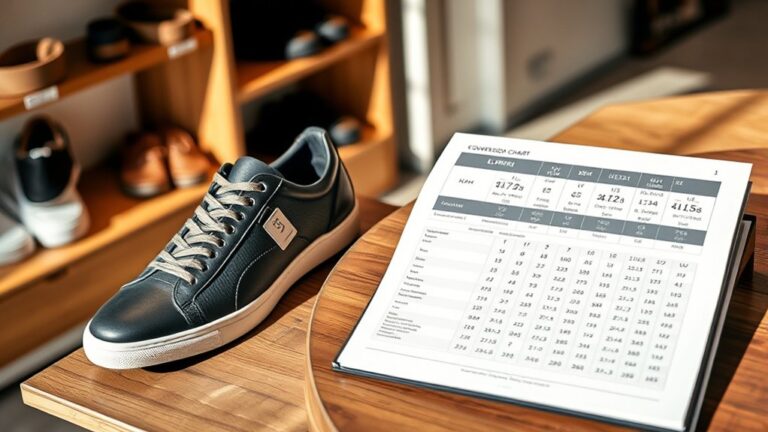
To navigate these differences, you’ll often rely on conversion charts, ensuring you select the right size across brands and styles without guesswork or discomfort.
How Shoe Size Numbers Start: Understanding Zero Points and Baselines
Because shoe size systems originate from different zero points or baselines, comparing sizes across regions requires careful attention to these starting measurements. Understanding shoe size history reveals that each regional sizing difference begins with a distinct baseline, which affects measurement scales.
Consider these key points:
Consider these key points to understand how different shoe size systems establish their unique baselines.
- Mondopoint defines size 0 as a foot length of zero millimeters, establishing a direct metric baseline.
- European sizes start at zero or one, with size 0 reflecting the inner shoe cavity length, not foot length.
- US women’s sizes use a baseline near 7 inches, creating a shifted zero point.
- UK sizes begin around 7⅔ inches, differing from US sizing despite similar origins.
How to Convert Inches to US, UK, and European Shoe Sizes
To convert your foot length in inches to US, UK, or European shoe sizes, you’ll want to use specific formulas that are designed for each region.
For example, when figuring out US sizes, you’ll subtract a certain amount based on whether you’re looking at men’s or women’s shoes before applying the standard scale.
Now, if you’re working with UK sizes, it’s a bit different. You’ll need to adjust your measurement by about one-third of an inch first. That little tweak helps get you closer to the right size.
European sizes take another route altogether. Here, you convert your foot length from inches to centimeters, then divide that number by 0.75.
This calculation gives you the European shoe size you should be looking for. It might sound a bit complicated at first, but once you try it, it’s pretty straightforward.
Inch-Based Size Formulas
When converting foot length from inches to shoe sizes, you’ll need to apply specific formulas tailored to each sizing system. Understanding these inch-based size formulas is essential for accurate shoe manufacturing. This ensures the shoe material fits properly and comfortably.
US men’s sizes start at size 1 for about 8⅓ inches. You add roughly 1 size for every 1/3 inch increase. It’s pretty straightforward once you get the hang of it.
US women’s sizes are a bit different. You need to add approximately 1.5 to 2 sizes to the measured length in inches to get the right size.
UK sizes begin at 7⅔ inches for size 1. It’s similar to the US system but offset by about one full size. So, keep that in mind when converting.
European sizes work differently. First, convert inches to centimeters by multiplying by 1.27. Then, add 2 for the Paris point-based size.
These formulas let you convert from inches precisely. This helps streamline shoe manufacturing and material selection, making the whole process smoother.
Regional Size Conversions
How do you accurately convert foot length measured in inches to shoe sizes across different regional systems? Start by measuring your foot in inches.
For US sizes, refer to sizing charts linking length to numerical values. Men’s sizes begin near 8.25 inches, while women’s start around 7.75 inches.
UK sizes generally run 1 to 2 sizes smaller than US. For example, a men’s size 9 in the UK equates to approximately 9.75 inches.
European sizes differ fundamentally, using Paris points where one size equals 0.75 cm. To convert, change inches to centimeters, then divide by 0.75 to find the size. For instance, 9.65 inches equals size 38.
Be mindful of regional sizing discrepancies caused by differing international shoe standards. It’s always a good idea to check brand-specific fit adjustments to ensure precise sizing across these systems.
That way, you get the best fit no matter where the shoes are from.
What Shoe Width Codes Mean and How to Choose the Right Fit
You’ll come across shoe width codes like A, B, D, and EE that tell you how narrow or wide a shoe is. These codes can vary a bit depending on the brand, so it’s good to keep that in mind.
When picking the right fit, think about the shape of your foot and what activities you’ll be doing in the shoes.
The width options usually correspond to measurements in millimeters, which match those letter codes.
It’s always best to try on shoes with the width code that matches your foot because sizing can differ from one manufacturer to another.
That way, you’re more likely to find a pair that feels just right.
Width Measurement Systems
Why do shoe width codes matter? They guarantee your shoe fits comfortably across the forefoot and heel, balancing support and style. Width codes like B, D, E, and EE guide you in selecting the right fit. This is vital because shoe material and fashion trends affect how a shoe conforms to your foot.
Width measurement systems vary.
First, letter codes (B, D, E) indicate narrow to wide fits but can differ by brand and region. Then, millimeter measurements specify foot ball width for precision. Narrow widths (AAA, B) suit slim feet, while wider widths (4E, 6E) accommodate broader feet.
Having an accurate width prevents discomfort, supports foot structure, and enhances shoe performance.
Understanding these systems really helps you navigate sizing charts more effectively.
Choosing Proper Width
Although shoe length often gets the most attention, selecting the correct width is just as important for comfort and foot health. Shoe width codes range from narrow (AAA or 2A) to wide (EE or 4E). These codes represent the space across your forefoot and heel.
To get the best fit, measure the widest part of your foot, which is usually at the ball.
In US sizing, standard widths are B for women and D for men. There are also wider options like W, EW, or 2E available.
Choosing the right width helps prevent pinching, blisters, and looseness. Keep in mind that brands vary slightly in their shoe width sizing.
The Mondopoint System: Measuring Foot Length and Width in Millimeters
While many sizing systems rely on arbitrary scales, the Mondopoint system measures your foot length and width directly in millimeters. It typically uses increments of 5 or 7.5 mm for precise accuracy. This method really helps improve sizing because it’s based on your actual foot measurement rather than the shoe last dimensions.
The system includes a few key measurements. First, foot length is measured in millimeters for exact sizing. Then, foot width is assessed between the first and fifth metatarsophalangeal joints.
Finally, foot perimeter is recorded at the same width points using a flexible tape.
Sizes are labeled with length and optional width, like 280/110 mm. This way, you get a clear idea of both how long and how wide the shoe is. Makes choosing the right fit a lot easier, right?
Tips for Getting the Perfect Shoe Fit Every Time
Because your feet can change size throughout the day, you should measure them barefoot at the end of the day when they’re largest to guarantee an accurate fit. Use a Brannock device or ruler to measure from the prominent toe to the heel, making sure your foot is flat and your weight is evenly distributed.
Measure your feet barefoot at day’s end for the most accurate shoe size and fit.
Allow 3-5 mm of space in the toe box to accommodate swelling and movement. Pick shoes with the right width labels like narrow, regular, or wide to match your foot shape.
When trying on shoes, fully secure laces or closures so you can check how snug they feel across the arch and heel without causing tightness.
Also, think about the shoe material because it affects flexibility and support, which are super important for keeping a proper fit and comfort all day long.
Frequently Asked Questions
Do Shoe Sizes in Inches Vary by Shoe Type?
Yes, shoe sizes in inches vary by shoe type because shoe manufacturing uses different sizing standards. Padding, shape, and design affect fit, so identical inch measurements can feel different across athletic, dress, or barefoot shoes.
It’s kind of like how different brands might fit differently even if the size is the same. So, don’t be surprised if your usual size feels a bit off depending on the shoe type you’re trying on.
Can Foot Length Change Throughout the Day?
Yes, your foot length fluctuates due to foot swelling and diurnal variation. Feet expand as fluids fluctuate, especially later in the day. This causes measurable increases in length that affect shoe fit and comfort considerably.
Are Children’s Shoe Sizes Measured in Inches Too?
Children’s shoe sizes aren’t typically measured in inches; you’ll find metric units more common.
When selecting, consider shoe material and shoe color, as they affect fit and comfort despite precise length measurements.
It’s not just about the numbers—how the shoe feels matters a lot too!
How Do Insoles Affect Shoe Size in Inches?
Insole thickness directly increases the shoe’s internal length by up to 0.2 inches. So, if your insoles provide arch support or cushioning, you might need a slightly larger size to maintain proper fit and comfort.
It’s a small change, but it can make a big difference when you’re trying to find the perfect fit. Think of it like adding a little extra padding inside your shoe that takes up space. That extra space means your foot needs a bit more room to stay comfortable.
Does Temperature Impact Foot Measurement in Inches?
You’ll find that temperature impacts foot measurement due to thermal expansion, so you must apply temperature calibration for accuracy. Even slight temperature changes cause tissue size shifts, affecting inch-based measurements and requiring consistent conditions for precision.
It’s kind of interesting how something as simple as temperature can change the size of your foot. That’s why keeping the environment steady when measuring is super important. Otherwise, your measurements might not be as reliable as you think.
Conclusion
Now that you know how to measure your foot length in inches, understand why sizes vary, and decode US, UK, EU, and Mondopoint systems, you’re equipped to find the perfect fit. Convert measurements accurately, interpret width codes confidently, and apply precise sizing methods.
With this knowledge, you’ll step into shoes that fit snugly, support firmly, and feel comfortable every time you walk, run, or stand. Finding the right shoe size doesn’t have to be confusing anymore. You’ve got this!