How Do Shoe Sizes Work – Complete Sizing Guide
To find your true shoe size, measure your foot length barefoot with even weight. It’s best to do this in the evening when your feet tend to swell.
Shoe sizes vary by region. The US and UK use barleycorn units with offsets, European sizes use Paris points, and Mondopoint reports millimeters for exact fits.
Remember, shoe length includes extra room beyond your foot length for comfort, and widths matter too. Understanding these differences and proper measuring helps guarantee a precise fit.
Take some time to explore how sizing systems relate to each other and how they affect your comfort. It’s worth it!
Key Takeaways
- Shoe sizes are based on foot length measured from heel to longest toe, with shoe length including extra allowance for comfort.
- Different regions use varying sizing systems: UK/US use barleycorn units, Europe uses Paris points, and Asia uses millimeters in Mondopoint.
- Children’s shoe sizes start smaller with extra growth room, while adult sizes begin higher and follow distinct measurement standards.
- Shoe width, indicated by letters or millimeters, is crucial for fit and varies widely to accommodate foot shapes.
- Accurate sizing requires measuring feet at the end of the day and cross-referencing with regional size charts for best fit.
Tips for Measuring Your Shoe Size Accurately at Home
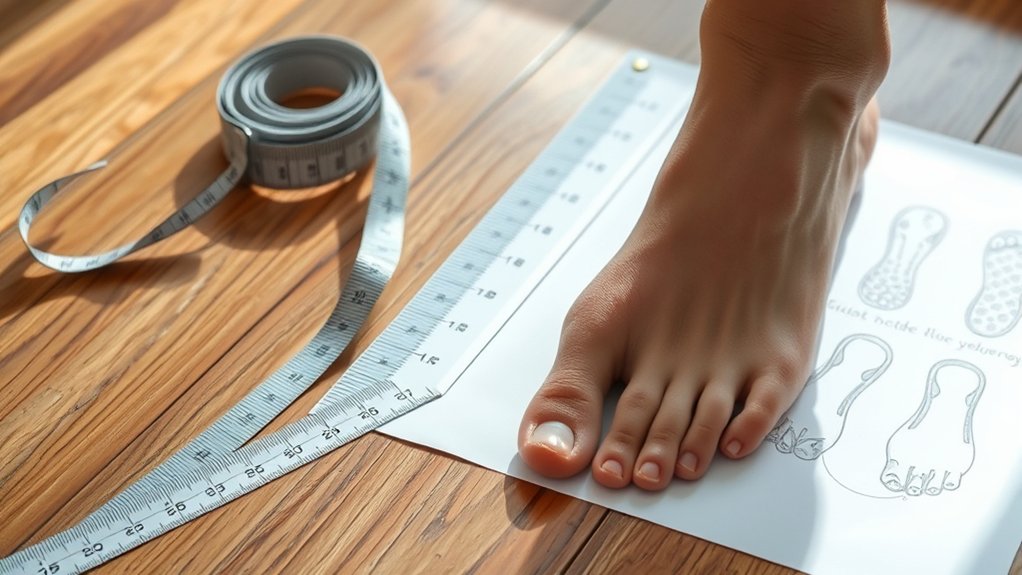
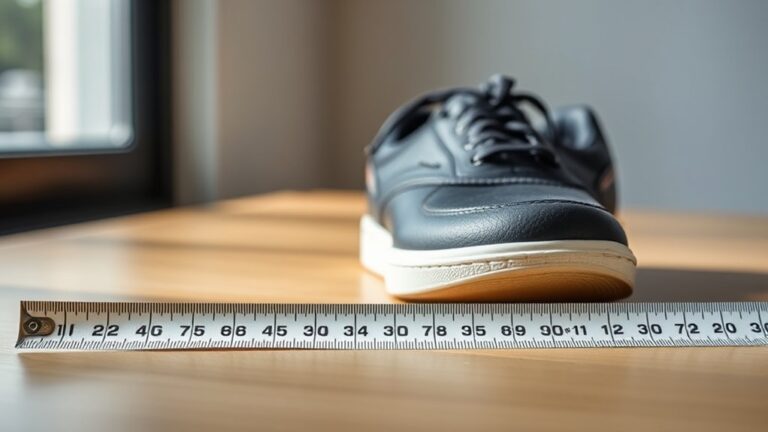
When measuring your shoe size at home, start by standing barefoot with your weight evenly distributed to guarantee an accurate foot length measurement. Place a ruler flat on the floor and mark the distance from your heel to the longest toe.
Alternatively, you can trace your foot outline on paper and measure the longest points.
Be sure to measure both feet since one may be larger than the other. Use the larger measurement for sizing to ensure comfort.
Don’t forget to check foot width at the ball’s widest part to figure out if you need narrow, regular, or wide shoes.
It’s best to perform measurements in the evening when your feet tend to swell a bit.
Also, keep in mind that shoe color and material can affect how the fit feels, so accurate sizing is key for both comfort and appearance.
No matter the style or fabric flexibility, getting the right size makes all the difference!
Foot Length vs. Shoe Length Measurement
When you measure your foot length, do it barefoot—from the heel all the way to your longest toe. This way, you get your true foot size accurately.
Now, the shoe’s inner length is a bit different. It’s actually longer than your foot measurement because it includes some extra space to let your foot move comfortably.
Foot Length Measurement Methods
Two primary methods exist for measuring foot size: foot length measurement and shoe length measurement. Foot length measurement involves gauging the distance from heel to longest toe while standing. This method directly ties to sizing charts, ensuring accuracy.
Shoe length measurement, on the other hand, measures the internal shoe length. This measurement is influenced by footwear material and padding, which affects the available space inside the shoe.
| Measurement Type | What It Measures | Key Considerations |
|---|---|---|
| Foot Length | Heel to longest toe | Direct correlation to sizing charts |
| Shoe Length | Internal shoe length | Influenced by padding, style, and insoles comparison |
| Comfort Factor | Wiggle room inside shoe | Affected by footwear material and construction |
Using both methods helps you select footwear that balances fit and comfort. It’s a smart way to make sure your shoes feel just right.
Shoe Inner Length Differences
Although foot length provides a direct measurement of your foot, shoe inner length is deliberately designed to be longer, usually by 1 to 1.5 centimeters, to accommodate natural foot movement and comfort. This sizing allowance varies slightly depending on shoe size and style. It typically ranges from 5 to 10 millimeters beyond your foot length.
Manufacturers factor in this extra space to prevent tightness while avoiding excessive looseness, ensuring an ideal fit. Properly measuring your foot length is essential to select shoes with the correct inner length. This means matching your foot plus the sizing allowance.
Additionally, some designs incorporate allowances for width and arch support. But the primary focus remains on inner length to balance comfort and functionality within the shoe’s structure.
Common Regional Shoe Size Systems Explained
You’ll notice that the UK and US systems both use barleycorn units, but they differ in their zero points and gender sizing. It’s kind of interesting how those small differences can affect the fit.
On the other hand, European sizes rely on Paris points, which scale foot length in centimeters by 0.75 increments. This really helps with precision.
Meanwhile, Asian standards often incorporate the Mondopoint system. This method measures foot dimensions directly in millimeters, aiming for an exact fit. It’s a pretty straightforward approach compared to the others.
UK And US Differences
When comparing UK and US shoe sizes, it’s important to understand that both systems use the length of the last measured in barleycorns. However, they differ in starting points and sizing offsets. UK sizes start at size zero for a 4-inch last, while US sizes offset by about 0.5 for men and 2 for women.
This difference affects fit, especially when you consider shoe material flexibility or orthopedic needs. For example, firmer materials may require precise sizing adjustments between systems.
| UK Size | US Men’s Size | US Women’s Size |
|---|---|---|
| 6 | 6.5 | 8 |
| 7 | 7.5 | 9 |
| 8 | 8.5 | 10 |
| 9 | 9.5 | 11 |
Always check brand-specific charts to find the best fit.
European Size Standards
Beyond the UK and US sizing systems lies the European standard, which measures shoe size differently by focusing on the length of the last in Paris points. One Paris point equals 2/3 of a centimeter (about 6.67 mm), and sizes increment by 3 Paris points, roughly 0.75 cm.
The formula (foot length in cm × 2) + 2 determines the size, emphasizing foot length without accounting for width or shape.
European sizes generally range from 35 to 46 for adults. When selecting shoes, consider that shoe material and sole thickness may slightly affect fit despite standardized lengths.
The European system’s consistent use across countries like Germany and France simplifies sizing. But keep in mind, those subtle factors can make a difference in comfort and performance.
Asian And Mondopoint
Although many regions rely on length-based sizing, Asian shoe size systems, such as the Japanese Industrial Standard (JIS), and the Mondopoint system measure foot dimensions directly in millimeters for enhanced accuracy.
The Mondopoint system specifies both foot length and width. For example, 280/110 indicates a foot length of 280 mm and a width of 110 mm, ensuring a precise fit.
Asian countries like Japan, China, and Korea widely adopt these systems to improve sizing accuracy and accommodate diverse foot shapes.
JIS sizes typically increase in 5 mm increments, reflecting exact foot measurement rather than approximations.
What Shoe Size Zero Means and Why It Matters
Since shoe size zero serves as the baseline in several sizing systems, understanding its definition is essential for accurate measurement and conversion. Shoe size zero either represents a foot length of zero millimeters or centimeters, as seen in Mondopoint and some European standards, or functions as the starting point on sizing charts.
Shoe size zero is the foundational baseline for accurate sizing and conversion across various systems.
In UK and US systems, size zero is uncommon in adult shoes but often marks the smallest size in children’s footwear.
Recognizing shoe size zero as the measurement baseline is important because it establishes the zero point from which all other sizes derive.
This clarity ensures precise scaling and facilitates accurate size conversions across diverse regional standards. It helps prevent mismatches and improves fit accuracy when comparing shoes internationally.
Differences Between Children’s and Adult Shoe Sizes
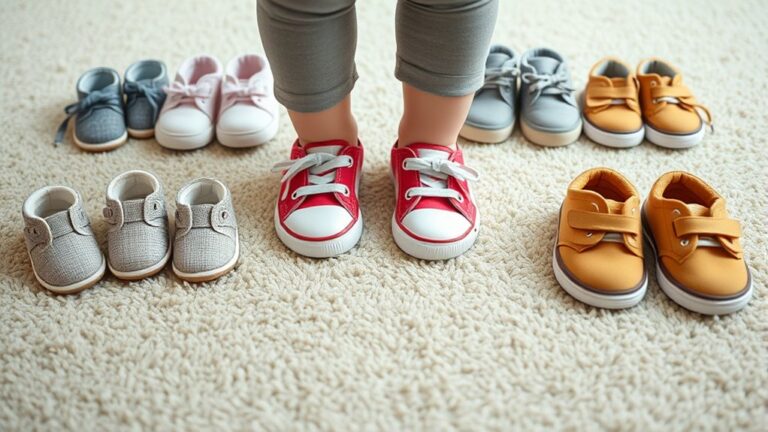
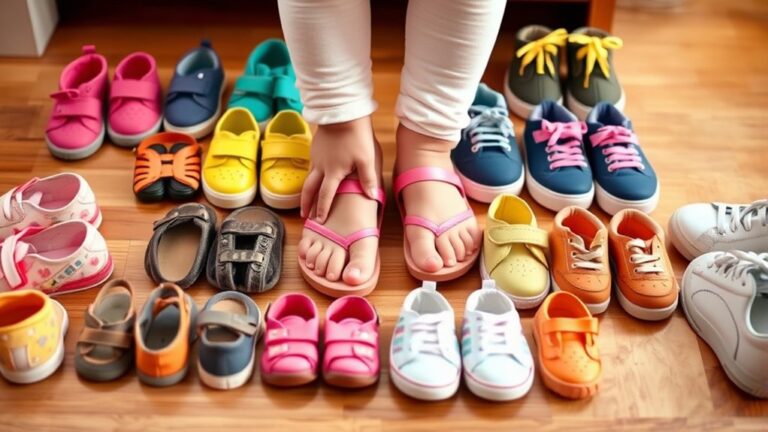
When you compare children’s and adult shoe sizes, you’ll notice that children’s sizes are smaller and organized into distinct categories for infants, toddlers, and older kids. Children’s sizing starts as low as US 0 or 1 and increases rapidly in increments of 1 to 1.5 sizes due to fast foot growth. These shoes provide extra room for growth, often several millimeters beyond actual foot length.
Adult sizing, by contrast, begins around US 4 or 5, with a different measurement system and conversion standards. Accurate foot measurement is vital to navigate these differences and guarantee proper fit. So, it really pays off to know exactly where your size falls.
| Category | Size Range (US) |
|---|---|
| Infant (Kids) | 0 – 4 |
| Toddler (Kids) | 4.5 – 8 |
| Older Kids | 8.5 – 13 |
| Adult | 4 – 15+ |
Understanding Shoe Widths and What They Mean for Fit
How do shoe widths impact your overall fit and comfort? Shoe widths, indicated by letters like B, D, E, and F, correspond to narrow through wide fits. These widths directly affect how a shoe fits.
In North America, widths range from AAA (very narrow) to 6E (extra wide). They’re measured precisely in millimeters or inches to accommodate different foot widths. Picking the right width means your toes have enough space, which helps prevent discomfort, pinching, or blisters.
Since brands and regions use different width standards, it’s super important to measure your foot width or try shoes on for the best fit. Many shoe models come in multiple width options within the same size, so you can find a fit that matches your foot’s shape.
Understanding shoe widths helps you avoid common fitting issues and makes wearing shoes much more comfortable overall.
Mondopoint: A Simple Way to Get the Perfect Fit
Although traditional shoe sizing can vary widely, Mondopoint offers a straightforward and exact method by measuring your foot length and width directly in millimeters. This system uses precise foot dimensions—expressed as length/width (e.g., 280/110)—to deliver a tailored fit that accommodates different foot arch shapes and guarantees ideal shoe cushioning placement.
By focusing on actual measurements, Mondopoint eliminates guesswork and enhances comfort, especially for specialized footwear and sports shoes where performance depends on fit accuracy. When you select shoes based on Mondopoint sizing, you’re addressing both foot length and girth, which supports proper arch alignment and effective cushioning.
This precision helps prevent discomfort and improves overall foot support, making Mondopoint a reliable choice for achieving your perfect shoe fit. It really takes the hassle out of finding shoes that feel just right.
How to Convert Between US, UK, and European Shoe Sizes
Since shoe sizes vary considerably across regions, converting between US, UK, and European measurements requires understanding their distinct sizing systems. US women’s sizes typically run from 4.5 to 10.5, and men’s from 5.5 to 12.5.
To convert UK sizes, add about 1.5 to 2 for women and roughly 1 for men. European sizes depend on foot length measured in centimeters, using Paris points (2 points = 1 cm).
Proper translation ensures accurate heel height positioning and arch support alignment, which is critical for comfort.
| UK Size | US Women | US Men | EU Size | Foot Length (cm) |
|---|---|---|---|---|
| 5 | 6.5 | 6 | 38 | 24.5 |
| 6 | 7.5 | 7 | 39 | 25.0 |
| 7 | 8.5 | 8 | 40 | 25.5 |
| 8 | 9.5 | 9 | 41 | 26.0 |
| 9 | 10.5 | 10 | 42 | 26.5 |
Using Shoe Size Charts for the Perfect Fit
When you want to guarantee a precise shoe fit, using a shoe size chart is essential. Start by accurately measuring your foot length and width, following the chart’s instructions closely. This measurement converts directly into standardized sizes across regions and brands, ensuring the shoe material matches your foot’s dimensions.
Accurately measure your foot using a size chart to ensure a precise, comfortable shoe fit across brands and regions.
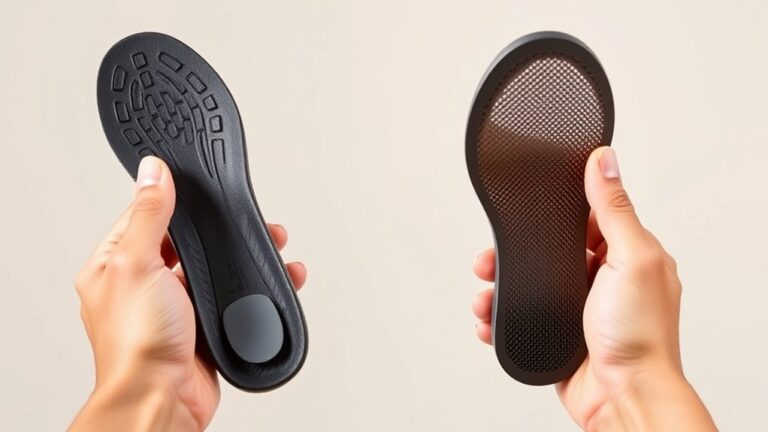
Considering shoe material is crucial since different materials stretch or compress differently, impacting fit. Also, proper sizing affects arch support effectiveness. An ill-fitting shoe can compromise arch alignment and comfort.
Shoe size charts cover Kids, Women, and Men, allowing you to select the correct size regardless of age or gender. Cross-referencing your measurements with the relevant chart prevents sizing errors.
This way, you get a comfortable fit that supports your foot structure and enhances overall performance.
Frequently Asked Questions
How Do Brands Handle Size Inconsistencies Across Different Shoe Models?
Brands handle size inconsistencies by prioritizing brand consistency through proprietary sizing standards. You’ll find detailed size charts and fit guides per model. These help you navigate variations caused by different styles and manufacturing processes effectively.
It’s all about making sure you get the right fit, no matter the shoe. So, even if sizes vary a bit, the guides keep things clear and simple. That way, you can shop with confidence every time.
Can Shoe Size Change Throughout Adulthood?
Your feet won’t suddenly balloon like balloons, but foot volume does subtly increase due to aging effects. You’ll notice bones and tissues stretch, so regularly checking your shoe size helps maintain comfort and guarantees an accurate fit throughout adulthood.
It’s a good idea to keep an eye on your shoe size now and then. That way, you avoid discomfort and make sure your shoes fit just right as you get older.
What Impact Do Shoe Materials Have on Fit and Sizing?
Material flexibility directly impacts fit adjustment. Flexible fabrics conform to your foot, allowing slight sizing variations, while rigid materials require precise sizing to avoid discomfort.
Choosing materials wisely guarantees ideal comfort and long-term fit stability. It’s all about finding that perfect balance between comfort and durability. So, think about the material when you’re picking your shoes—it really makes a difference!
Are Specialty Shoes Sized Differently Than Regular Shoes?
You won’t find specialty shoes sized like regular ones; shoe manufacturing here follows unique sizing standards. They focus more on foot shape and biomechanics.
Precise measurements replace general sizes, so you’ll need careful fitting to guarantee an accurate, natural fit. It’s a bit different from just picking your usual size off the shelf.
Basically, specialty shoes are made to match your feet more closely, which means better comfort and support overall.
How Do Orthotics Affect Shoe Size and Fit?
Orthotics increase insole thickness and provide arch support, which affects shoe volume. You’ll likely need a larger size to accommodate added thickness without tightness. This helps ensure proper fit and comfort while maintaining natural foot movement inside the shoe.
It’s all about making sure your feet feel good and don’t get cramped. So, don’t be surprised if your usual size doesn’t quite work once you add orthotics. A little extra room can make a big difference!
Conclusion
So, after all that measuring, converting, and decoding shoe sizes, you’d think finding your perfect fit is a walk in the park. Right? Instead, you might feel like you’ve just solved a complex math problem with your feet.
But now, armed with precise methods and charts, you can stride confidently. Knowing that shoe size zero isn’t a mystery and width matters as much as length is pretty cool. Who knew your feet had their own secret language?