What Is A Size 38 Shoe In Us – Conversion Chart Guide
A European size 38 shoe typically converts to a US women’s size 7.5 to 8 and a men’s size 6.5 to 7, based on a foot length near 24 cm. Keep in mind, widths differ. Women’s standard is B, and men’s is D. Brand-specific sizing can affect the exact fit.
Make sure to measure your feet while standing using proper tools. It’s best to wear socks similar to those you plan to use with the shoes. This will help guarantee accuracy.
Understanding these basics makes it easier to pick the right size. That way, you can feel confident and comfortable with your choice.
Key Takeaways
- European size 38 generally converts to US women’s sizes 7.5–8 and men’s sizes 6.5–7.
- Size 38 corresponds to a foot length of approximately 24 centimeters or 9.45 inches.
- UK size for a European 38 is typically 5, while Australian size is around 8.
- Always check brand-specific size charts due to variations in sizing standards and shoe construction.
- Measuring feet accurately with a ruler while standing and using the larger foot size improves fit reliability.
What Size 38 Means in European Shoe Sizing
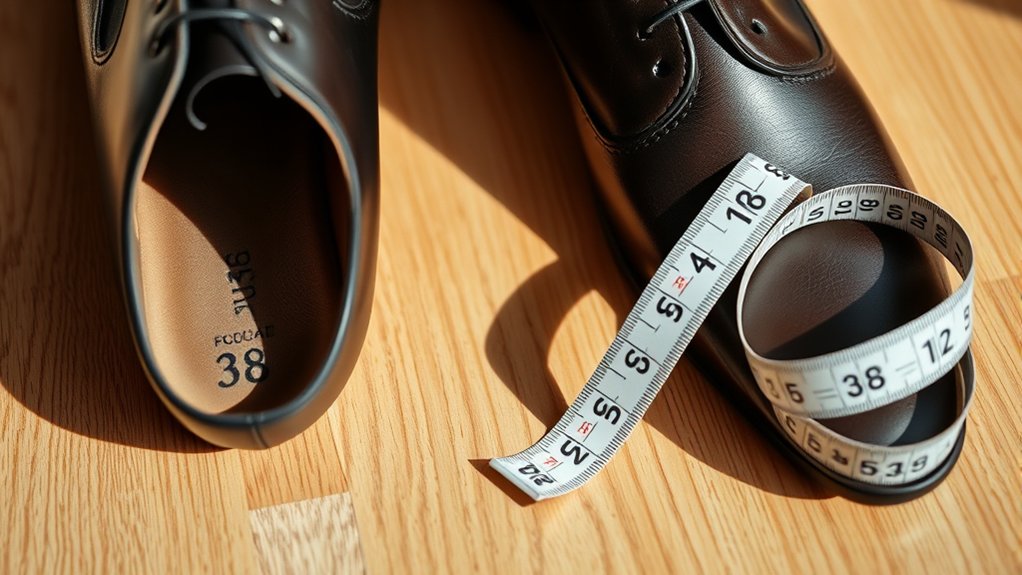
When you see a European shoe size 38, it typically corresponds to a US women’s size between 7.5 and 8, or a US men’s size around 6.5 to 7.
European sizes use Paris points, where size 38 indicates a foot length near 24 centimeters.
European shoe size 38 corresponds to a foot length of approximately 24 centimeters using Paris points.
This measurement standard guarantees consistency, but remember, exact US equivalents can vary by brand and shoe style. Staying updated on fashion trends means you’ll often encounter different fits even within size 38.
So, it’s a good idea to check specific brand conversion charts for accurate sizing.
Also, understanding your shoe’s size helps with effective shoe maintenance. Well-fitted footwear reduces wear and improves durability.
Knowing what a size 38 truly represents lets you make informed choices for both comfort and style.
Converting Size 38 to US Women’s and Men’s Sizes
To convert a size 38 shoe from European sizing to US measurements, you’ll typically find it aligns with US women’s sizes 7.5 to 8.0 and men’s sizes 6.5 to 7.0. Keep in mind, footwear aesthetics and shoe material can influence fit, so always consult brand-specific charts.
Measuring your foot length in centimeters helps ensure accuracy.
| Category | US Size Range |
|---|---|
| Women’s Size (EU 38) | 7.5 – 8.0 |
| Men’s Size (EU 38) | 6.5 – 7.0 |
| Foot Length (cm) | ~24.0 |
| Shoe Material | Affects fit |
| Footwear Aesthetics | May alter sizing |
Use this table as a baseline when converting size 38 shoes to US sizes for precise fitting.
Comparing Size 38 to UK and Other Regional Sizes
Three key regional sizing systems, UK, Australian, and European, differ slightly when converting a size 38 shoe.
In footwear fashion, a European size 38 corresponds to a UK size 5, reflecting a standard regional conversion. Meanwhile, Australian sizing aligns closely but registers a size 8 for the same foot measurement.
These variations highlight the challenges in achieving sizing consistency across markets. Since size 38 typically fits feet about 9.25 inches (23.5 cm) long, you have to consider these differences carefully when selecting shoes internationally.
Sizing differences complicate international shoe shopping, making careful measurement essential for the perfect fit.
Because brands may have unique sizing nuances, verifying specific brand conversion charts is vital for precision.
Understanding these regional sizing distinctions ensures you maintain accuracy and comfort in your footwear fashion choices. This way, you avoid common pitfalls in cross-regional shoe buying.
How to Measure Your Foot for a Size 38 Fit
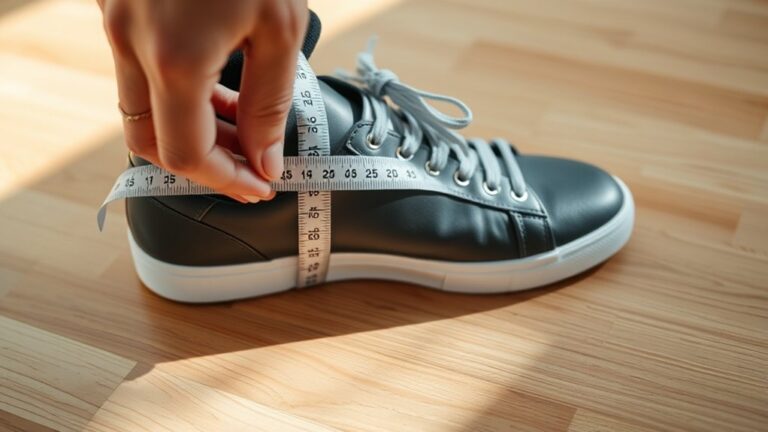
To measure your foot accurately for a size 38 fit, start by grabbing a ruler or a Brannock device.
Stand up and measure the length from your heel to your longest toe. It’s important to do this while standing because your foot spreads out a bit under your weight.
Make sure to measure both feet, since one might be slightly bigger than the other. Take note of both inches and centimeters, and go with the larger measurement for the best fit.
Don’t forget about the width of your foot, too—it can make a big difference in comfort.
Also, it’s a good idea to wear the socks you plan to use with the shoes when you measure. This way, you’ll get a more accurate sense of how the shoes will fit.
Once you have your measurements, you can check them against the size conversion chart to find your perfect size 38.
Measuring Foot Length
Although measuring your foot length may seem straightforward, accuracy is essential when determining a size 38 fit.
Stand barefoot on a hard surface, making sure your foot is flat. Use a ruler or measuring tape to measure from the tip of your longest toe to the back of your heel.
Measure both feet, as one may be larger. Use the larger measurement for precise shoe fitting.
It’s best to wear socks similar to those you’ll use with the shoes to reflect realistic foot dimensions.
Record your foot length in centimeters or inches, matching the unit to the sizing chart you’ll consult.
Comparing this measurement against the chart ensures your size 38 shoe will provide an accurate and comfortable fit based on your actual foot length.
Using Proper Tools
How can you guarantee your foot measurement is accurate enough to select a size 38 shoe? Using proper tools is essential for measurement accuracy and optimal footwear fit. Follow these steps:
First, use a ruler or Brannock device to measure from heel to toe while standing upright. Make sure you’re wearing socks or stockings similar to those you’ll use with the shoes for consistent measurement conditions.
Measure both feet and record the larger foot’s length in inches or centimeters, matching the unit on your sizing chart.
Then, refer to a conversion chart to correlate your measurement, typically around 9.25 inches (23.5 cm), to a US size 38 shoe.
Taking accurate measurements like this helps you pick footwear that fits properly. That way, you avoid discomfort and sizing errors.
Accounting For Foot Width
Why does foot width matter when selecting a size 38 shoe? Foot width directly impacts comfort, support, and footwear aesthetics. These are vital elements in shoe manufacturing.
To measure accurately, stand barefoot with your weight evenly distributed. Use a ruler or measuring tape to measure the widest part of each foot in inches or centimeters. Record both measurements, then base your shoe width choice on the larger foot to guarantee a proper fit.
Compare your measurements to standard width categories like narrow, medium, or wide using a reliable foot width guide. Since widths vary by brand and style, make sure to check specific size 38 width charts before purchasing.
Accounting for foot width optimizes comfort without compromising footwear aesthetics. It aligns with precise shoe manufacturing standards to ensure a perfect fit.
Understanding Width Differences for Size 38 Shoes
When selecting size 38 shoes, you need to consider width variations because they directly impact fit and comfort. Shoe width affects how well the shoe accommodates your foot volume. This influences stability and pressure points.
Here are some key points to understand:
- Width ranges for size 38 go from narrow (A, 2A) to wide (E, 2E), which changes the shoe’s internal dimensions.
- Women’s size 38 usually uses a B (medium) width, while men’s size 38 aligns with a D (standard) width.
- Width measurements are often given in inches. Narrow widths measure around 2.0 inches, and wide widths are over 2.5 inches.
- Picking the right width makes sure your shoes fit well, especially if your foot volume isn’t average.
Choosing the correct width helps avoid discomfort and makes your shoes perform better. So, it’s definitely worth paying attention to!
Why Shoe Sizes Vary by Brand and Style
Selecting the correct width is only one part of ensuring a proper fit for size 38 shoes. Variations between brands and styles also play a significant role. Different brands use distinct last shapes and manufacturing standards, which affect width, volume, and overall fit.
Proper fit goes beyond width; brand-specific shapes and standards greatly influence shoe comfort and sizing.
Even though European sizing like size 38 is standardized, its conversion to US sizes can differ slightly depending on the brand. Plus, shoe material impacts flexibility and stretch, which influences comfort considerations.
For example, athletic shoes often feature more adaptable materials and cushioning compared to rigid formal shoes. This changes the fit profile even within the same size.
Because of these factors, relying solely on generic conversion charts isn’t enough. It’s really important to check brand-specific sizing information to accommodate differences in construction, material, and intended use.
Tips for Choosing the Right Size When Buying Online
Although buying shoes online offers convenience, making sure you get the right size takes a bit of preparation. You should consider fashion trends and the shoe material because these can affect how the shoe fits and feels.
Here are some tips to help you get it right:
- Measure both feet in centimeters or inches, then pick the size that matches your larger foot.
- Always check the brand-specific size chart since sizes can differ between manufacturers.
- Take a look at customer reviews to see if the shoe fits true to size or runs a bit small or large.
If you’re unsure, it’s usually safer to go for a half or full size bigger—especially if you plan to wear thicker socks or want extra comfort.
How to Use Shoe Size Conversion Charts and Calculators
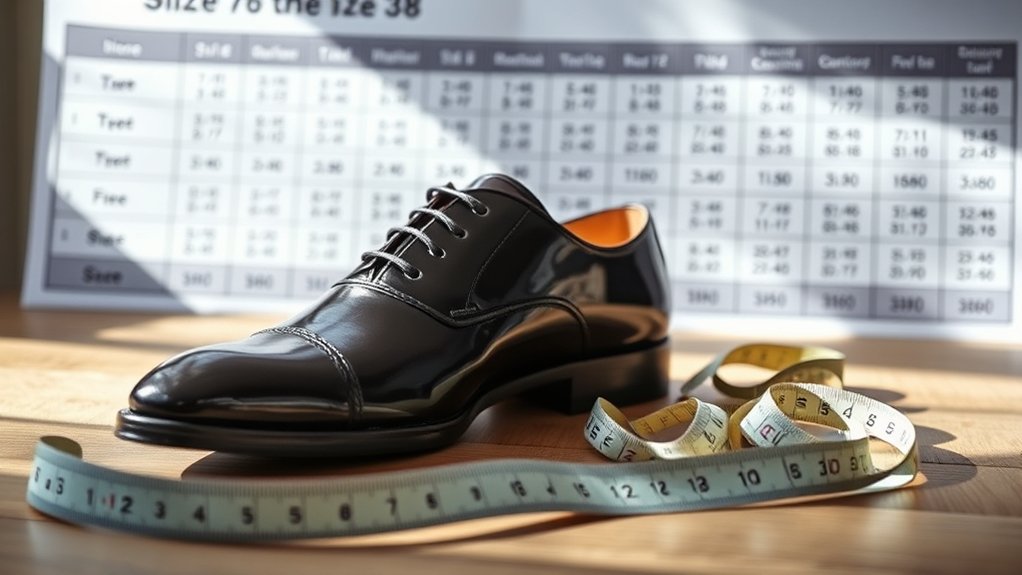
Since shoe sizes vary widely across regions and brands, using conversion charts and calculators helps you find the exact equivalent of your size in another measurement system. First, measure your foot length accurately in centimeters or inches. Then, locate your size in the chart to identify the corresponding size in the US, EU, or UK systems.
Online calculators simplify this by automatically converting sizes based on your input. Keep in mind, shoe material and fashion trends can affect fit, so always consider brand-specific details. Use the table below as a quick reference:
| EU Size | US Size |
|---|---|
| 36 | 5.5 |
| 37 | 6.5 |
| 38 | 7.5 |
| 39 | 8.5 |
| 40 | 9 |
Common Mistakes to Avoid When Converting Shoe Sizes
When converting shoe sizes, it’s best not to rely on imprecise measurement methods that overlook things like foot width and shape. Those details really matter.
Plus, you’ve got to keep in mind that sizing can vary between brands—a size 38 in one brand mightn’t be the same in another.
Ignoring these differences often leads to a poor fit and discomfort, which nobody wants.
Incorrect Measurement Techniques
To guarantee accurate shoe size conversion, you must avoid common measurement errors that skew your results. Incorrect techniques often lead to ill-fitting shoes, especially when shoe material and heel height affect fit.
Don’t use a flexible tape measure. It bends and distorts foot length readings. Instead, opt for a rigid ruler.
Measure your feet while standing to account for natural foot expansion under weight.
Always measure both feet. Choose the larger size to accommodate differences and avoid discomfort.
Wear the type of socks or stockings you plan to use with the shoes. Omitting them can underestimate your foot size.
Avoiding these errors ensures your size 38 shoe conversion to US sizing accurately reflects your true foot dimensions. It also helps accommodate shoe design variables.
Ignoring Brand Size Variations
Although general size conversion charts provide a useful starting point, ignoring brand-specific sizing variations can cause significant fitting issues. You must recognize that brand consistency is rarely absolute; sizing discrepancies often exist even within the same numerical size.
Assuming that a European size 38 universally converts to a specific US size without consulting the brand’s sizing guide increases the risk of improper fit. Overlooking these nuances can lead to shoes that are either too tight or too loose, causing discomfort.
To avoid these errors, always measure your foot accurately and compare it against the individual brand’s sizing recommendations. This step guarantees precise conversion and reduces the likelihood of ordering mistakes due to overlooked brand-specific standards.
Frequently Asked Questions
How Do Temperature Changes Affect Shoe Size Fit?
You’ll notice temperature expansion causes your feet and shoes to change size. Warmer conditions increase foot volume, while shoe flexibility helps accommodate this.
Cooler temperatures reduce swelling, making shoes feel looser. This changes the overall fit in a pretty dynamic way. It’s interesting how much temperature can affect something as simple as shoe size!
Can Insoles Alter the Effective Shoe Size?
Oh, insoles won’t magically change your shoe size. But with insole customization and precise shoe fitting techniques, they can reduce the internal volume. This makes your shoes feel tighter, effectively altering the fit without changing the actual size.
What Materials Are Best for Size 38 Shoe Comfort?
You’ll find footwear materials like flexible leather, breathable mesh, and memory foam insoles optimize size 38 shoe comfort. These materials adapt well to shoe sizing, providing support, moisture control, and shock absorption for a precise fit.
They really help make your shoes feel like they were made just for you. Plus, these materials keep your feet comfortable throughout the day, no matter what you’re up to. So, when you’re picking out size 38 shoes, look for these features to get the best comfort possible.
How to Care for Size 38 Leather Shoes?
You should regularly clean and polish your size 38 leather shoes. This helps keep them looking great and protects the leather. After cleaning, don’t forget to apply leather conditioner to maintain their suppleness.
Make sure to store your shoes properly. Avoid exposing them to moisture, which can damage the leather over time. Using shoe trees is a smart move—they help preserve the shape and prevent damage effectively. Taking these simple steps will keep your shoes in top condition for longer.
Are There Specific Socks Recommended for Size 38 Shoes?
Coincidentally, socks designed for size 38 shoes focus on sock thickness and material, balancing breathability and cushioning. You’ll want thinner socks for snug fits, thicker ones for comfort. Plus, moisture-wicking fabrics help keep your feet dry.
Choosing the right sock really comes down to what feels best for you. Think about where you’ll be wearing them and how active you’ll be. That way, you can find the perfect pair that fits just right and feels great all day long.
Conclusion
Finding your way through shoe sizes can feel like decoding a secret map. But knowing that a size 38 in European sizing typically equals a US women’s 7.5 or men’s 6.5 will keep you on the right path.
By measuring your foot carefully and using conversion charts, you’ll step confidently into the perfect fit. Remember, brand quirks and width variations can shift the journey. So, stay precise and avoid common pitfalls for a flawless stride every time.