How To Measure Foot For Shoe Size – Accurate Fit Guide
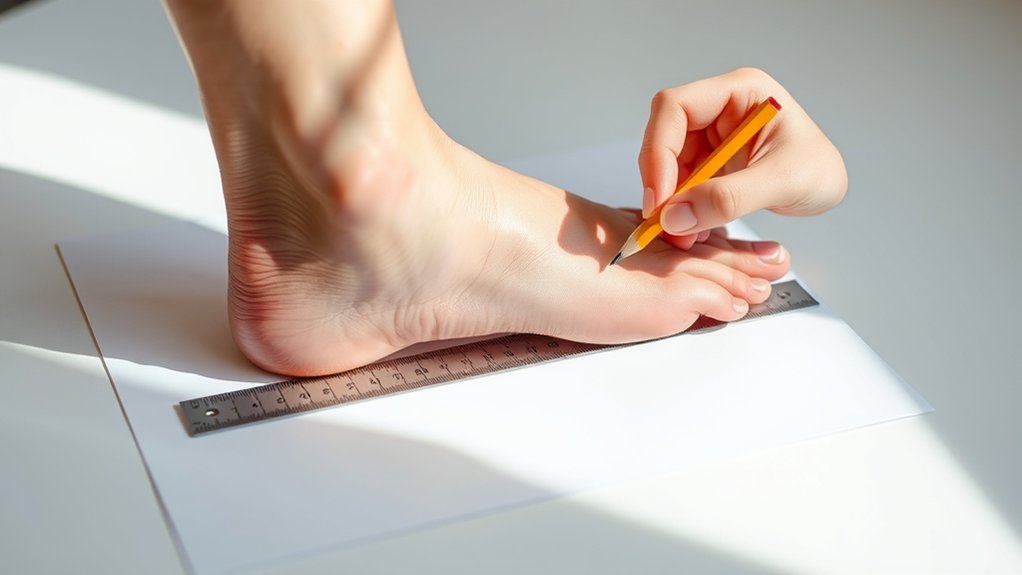
To measure your foot accurately for shoe size, stand barefoot on a hard surface with even weight distribution. Trace your foot on taped paper, marking the heel and longest toe. Measure both length and width, using the larger measurements for fit.
Do this at the day’s end when feet are fullest. Compare your results with brand size charts, like Nike’s, to find the best match. Understanding these steps guarantees comfort and support.
You’ll also learn more about fit nuances ahead, so stick with it! This simple process really helps you get shoes that feel just right.
Key Takeaways
- Stand barefoot on a hard, flat surface and measure from the heel to the tip of the longest toe for accurate foot length.
- Measure foot width across the widest part of the ball of the foot with a snug but not tight tape.
- Measure both feet at the end of the day and use the larger foot’s measurements as the reference.
- Trace the foot outline on paper with weight evenly distributed for precise length and width measurements.
- Use measurements with brand-specific size charts, allowing extra room for toe movement and foot expansion.
How To Measure Your Foot Length And Width Accurately At Home
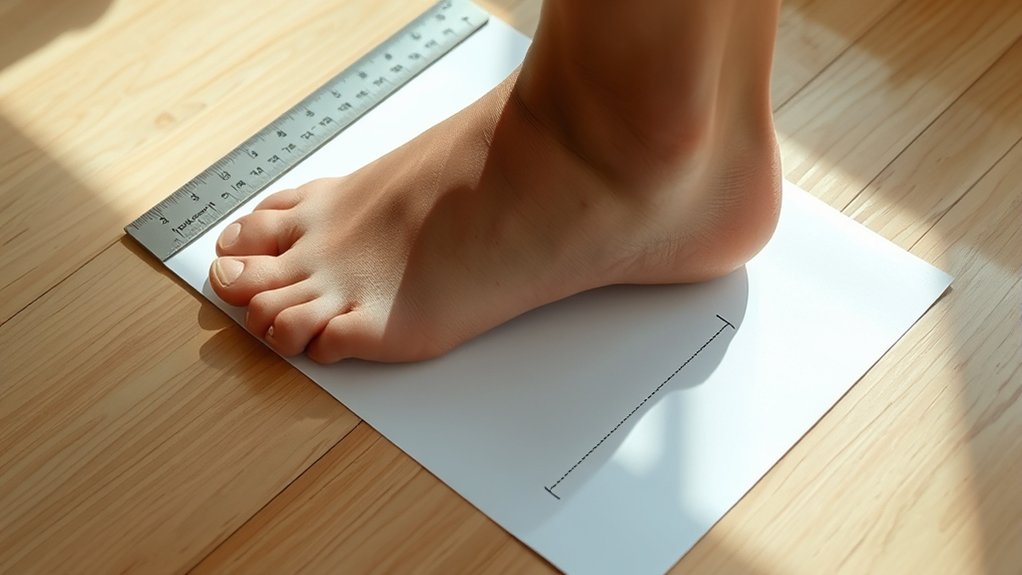
Although it might seem simple, measuring your foot length and width accurately at home requires specific steps to guarantee the best fit.
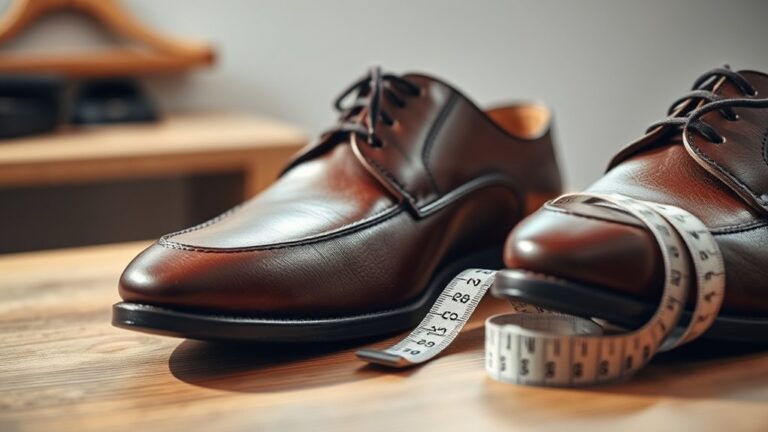
Stand barefoot on a hard, flat surface with your weight evenly distributed. Use a ruler or tape measure to record the arch length from your heel’s back to the tip of your longest toe. Focus on the toe span to capture the full length.
Make sure to measure both feet and use the larger measurement as your reference since one foot is often slightly bigger.
For width, measure the widest part across the ball of your foot, keeping the tape snug but not tight. Taking these precise measurements ensures you account for your foot’s true dimensions.
This way, you’ll have a reliable basis for selecting well-fitting shoes that feel comfortable all day long. It’s a simple process but really makes a difference when picking the right size.
When Should You Measure Your Feet For The Best Shoe Fit?
Because your feet tend to swell throughout the day, the best time to measure them is at the end of the day when they’re at their largest. This guarantees the shoe fit will accommodate natural foot expansion, preventing discomfort.
You should also measure your feet regularly, especially during seasonal changes or if you experience any foot pain.
Before buying new footwear, particularly online or when trying a different brand, measure both feet and use the larger measurement for accuracy.
This helps you select shoes that suit your exact foot dimensions and the specific shoe material, which can affect fit and stretch.
Staying precise with measurements allows you to enjoy footwear fashion that fits comfortably and supports foot health consistently.
How To Use Your Foot Measurements With Nike Size Charts
You should start by comparing your foot length precisely with Nike’s size charts. Make sure to pay close attention to their gender-specific measurements.
If you need to convert sizes between men’s and women’s charts, just use Nike’s conversion guidelines to get it right.
Also, don’t forget to consider width variations — this can really make a difference in comfort and performance.
Compare Foot Length Precisely
When comparing your foot length with Nike’s size charts, start by accurately measuring from the longest toe to the heel on a piece of paper.
Use the measurement of your longer foot if there’s a size difference, ensuring the best fit.
Convert your measurement to the units used in Nike’s regional size chart—US, EU, or UK—for precise comparison.
Keep in mind that shoe fit can vary by model, so always consult the specific chart for the style you want.
Proper foot arch support and shoe breathability also influence comfort, so choosing the right size is crucial.
By precisely comparing your foot length with Nike’s charts, you optimize fit, enhancing both performance and comfort.
It’s all about making sure your shoes feel just right!
Convert Sizes Between Genders
Three key steps help you convert Nike shoe sizes accurately between men’s and women’s categories using your foot measurements.
First, measure your longer foot precisely. Consider shoe width and arch support needs for the best fit.
Second, use Nike’s official size charts to convert sizes: subtract 1.5 to go from women’s to men’s sizes, and add 1.5 for men’s to women’s sizes.
Third, always check the specific Nike model’s chart since sizing can vary slightly by style.
Remember, these conversions apply to US sizes only. If you shop internationally, verify European or UK equivalents separately.
Following this method guarantees your shoe size conversion accounts for both gender differences and your foot’s unique shape.
Consider Width Variations
Although length is often the primary focus in shoe sizing, width variations play an equally crucial role in ensuring a comfortable fit. Use your foot width, measured at the widest part, to decide if you need standard, wide, or extra-wide Nike shoes. Remember to factor in footwear arch and sock thickness, as these influence the overall fit.
Nike’s width sizing charts specify widths like B (medium) for women and D (standard) for men. Be sure to consult these when matching your measurements.
| Width Category | Nike Size Label |
|---|---|
| Standard | B (women), D (men) |
| Wide | W |
| Extra-Wide | XW |
Choose models with wider lasts, such as Nike Pegasus or Monarch. Always verify model-specific width options for the best fit.
What’s The Difference Between Men’s And Women’s Nike Sizes?
Since Nike sizes differ between men and women, understanding these variations helps you choose the right fit. Women’s Nike sizes are generally about 1.5 sizes smaller than men’s; for example, a women’s size 8 matches a men’s 6.5. This consistent difference applies across Nike’s U.S. sizing system, making conversions straightforward when you consult Nike’s official size charts.
When selecting shoes, consider that shoe material and arch support might feel different between men’s and women’s models, even if the size converts accurately.
Nike also offers unisex sizing, but verifying product-specific details guarantees precise fitting.
How To Choose Wide Or Extra-Wide Nike Shoes For Wider Feet
When you have wider feet, choosing the right Nike shoe width becomes vital for comfort and performance. Nike offers specific wide (D/E) and extra-wide (2E/EE) options, such as the Pegasus and Monarch models, tailored for wider feet.
To guarantee proper wide shoe fitting, measure your foot length and add about 1/4 inch (6-7 mm) to accommodate extra space.
Always check shoe width labels in product descriptions or size charts to confirm the availability of “Wide” or “Extra Wide” sizes.
If you’re between standard and wide sizes, consider sizing up half a size to prevent pinching and enhance comfort.
Trying on different Nike styles is essential to find the best fit that supports your foot’s width and overall comfort.
Common Signs Your Nike Shoes Don’t Fit And How To Check At Home
If your Nike shoes cause tightness, pinching, or irritation in the toe box or heel, they likely don’t fit properly. Watch for blisters, redness, or soreness. These usually signal poor alignment with your foot arch or not enough shoe cushioning.
Heel slipping means the size might be too big or the ankle fit too loose. To check at home, wear the shoes and mimic natural walking or jogging. This helps you see if they feel comfortable and supportive.
| Sign | Cause | Home Check |
|---|---|---|
| Toe box tightness | Narrow fit or low cushioning | Wiggle toes; feel for pressure |
| Heel slipping | Large size or loose fit | Walk and notice shoe movement |
| Arch misalignment | Incorrect arch support | Observe foot landing pattern |
How Foot Shape And Nike Shoe Design Affect Fit And Comfort
Recognizing common fit issues like tightness or heel slipping is just one step toward finding the right Nike shoe for your foot. Your foot shape, especially your foot arch and width, plays a vital role in how Nike shoes fit and feel. Nike designs use specific shoe lasts, which are molds shaping the shoe, tailored to various foot contours.
If you have a wide or high-arched foot, you’ll benefit from Nike models with broader toe boxes or enhanced arch support to guarantee comfort and stability. Since shoe lasts differ by model and intended activity, understanding your foot’s unique shape helps you select Nike shoes that offer proper arch support, adequate toe room, and a secure fit.
This way, you can prevent discomfort during wear and enjoy your shoes more.
How To Measure Kids’ Feet And Find The Right Nike Shoe Size
Accurately measuring your child’s feet is essential for selecting the right Nike shoe size and guaranteeing comfort during growth. Measure their feet at the end of the day when swelling peaks, using a hard floor and tape to secure paper.
Measure your child’s feet at day’s end on a hard floor to ensure the perfect Nike shoe fit.
Have your child stand evenly, then trace their foot, marking the longest toe and heel. Measure the longer foot’s length and consult Nike’s kids’ size charts.
Confirm the shoe length surpasses the longest toe by a fingertip’s width, allowing toe movement. Consider your child’s foot arch types to choose the right Nike model.
Apply proper shoe lacing techniques to enhance fit and support. Regularly re-measure every few months to accommodate growth and maintain an ideal fit as your child’s feet develop.
It’s a simple routine that keeps their shoes comfortable and supportive as they grow.
Tips For Converting Nike Shoe Sizes Between Men’s, Women’s, And Kids’
When you’re converting Nike shoe sizes between men’s, women’s, and kids’, understanding the size differences is essential for selecting the right fit.
Nike men’s sizes generally run 1.5 sizes larger than women’s, so subtract 1.5 to convert women’s sizes to men’s, or add 1.5 for the reverse.
Kids’ sizes fall between youth and toddler ranges. Youth sizes 3.5 to 6.5 correspond roughly to adult sizes 4 to 6.
When converting, always check Nike’s official size charts and use foot length measurements in centimeters or inches for precision.
Remember, the shoe material and arch support features can also affect fit and comfort.
Frequently Asked Questions
How Often Should I Re-Measure My Feet for Accurate Shoe Sizing?
You should re-measure your feet every 6 to 12 months using proper foot measurement techniques.
It’s a good idea to follow shoe fitting tips, especially during growth, weight changes, or if you start feeling any discomfort.
That way, you can keep your sizing accurate and make sure your shoes stay comfortable.
Can Foot Swelling Affect Shoe Size Throughout the Day?
Foot swelling changes your shoe size and causes daily fluctuations. It also requires attention to avoid discomfort.
You’ll notice your feet expand throughout the day. So, choosing shoes in the evening guarantees a comfortable, accurate fit every time.
What Materials Offer the Best Support for Wide Feet?
You’ll find arch support and cushioning materials like EVA foam and memory foam ideal for wide feet. These provide stability and comfort, while flexible leathers or synthetic fabrics adapt to your foot’s shape, ensuring a perfect fit.
They really work together to give your feet the support they need without feeling too tight or restrictive. Plus, these materials can make a big difference if you’re on your feet a lot. So, when choosing shoes, keep an eye out for these features—they’re game changers for wide feet!
How Do Orthotics Impact Shoe Size and Fit?
Orthotics can feel like fitting a spaceship in your shoe! You’ll need orthotic accommodation because added foot arch support increases volume.
This often means you might need to go up a size to maintain comfort. Otherwise, you risk tightness or foot slippage inside your shoes.
It’s all about making sure your feet have enough room to move comfortably with the orthotics in place.
Are There Differences in Sizing for Athletic vs. Casual Nike Shoes?
Yes, Nike’s athletic shoes usually have a narrower shoe width and firmer arch support for performance. Meanwhile, casual styles offer a roomier fit and softer arch support for comfort.
Conclusion
Think of measuring your feet like charting a map before a journey. Without an accurate guide, you risk wandering in ill-fitting shoes.
By taking precise measurements and understanding Nike’s sizing nuances, you make certain every step is confident and comfortable. Just like a skilled navigator adjusts course for terrain, you can tailor your shoe choice to your unique foot shape and size.
This careful preparation guarantees your footwear supports every stride, every day.