What Is My European Shoe Size – Conversion Guide And Chart
To find your European shoe size, measure your foot length in centimeters at the end of the day. Use the larger foot if they differ. European sizes run unisex and are about 0.67 cm apart.
To convert from US sizes, add roughly 33–34 for men and 30–31 for women. Keep in mind brand differences and styles vary each year. So, checking specific guides helps.
For more on kids’ sizes, common issues, and expert tips, keep exploring this guide.
Key Takeaways
- Measure your foot length in centimeters at the end of the day for the most accurate European shoe size.
- Convert US sizes to European by adding 30 to 34, with men’s US 9 roughly equaling EU 42 or 43.
- European shoe sizes are unisex and based on foot length, increasing about 0.67 cm per size.
- Always consult specific brand size charts due to variations and style differences for the best fit.
- Use the larger foot measurement when sizing and consider half sizes or width options for comfort.
Measuring Your Foot for European Shoe Size Accuracy
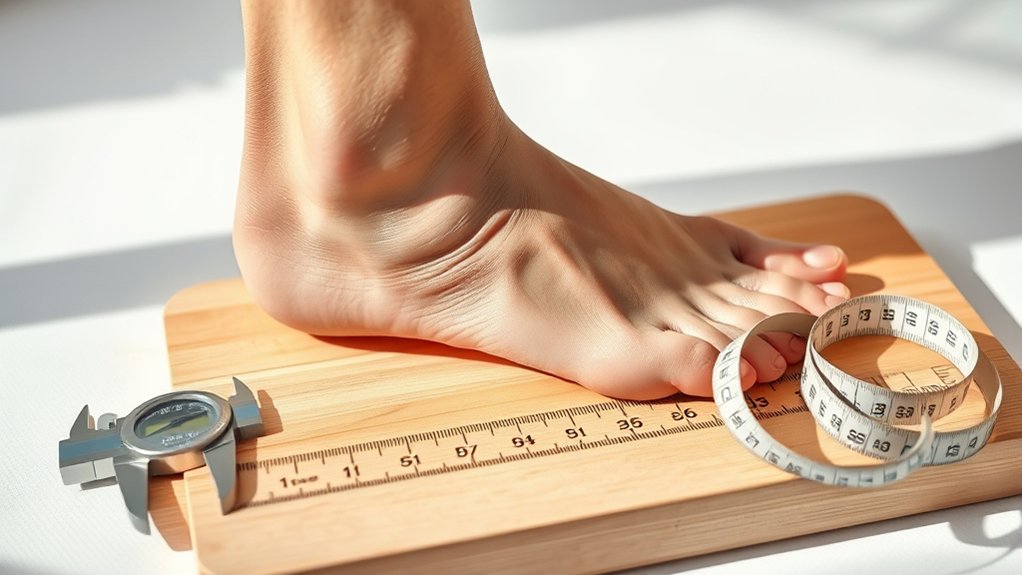
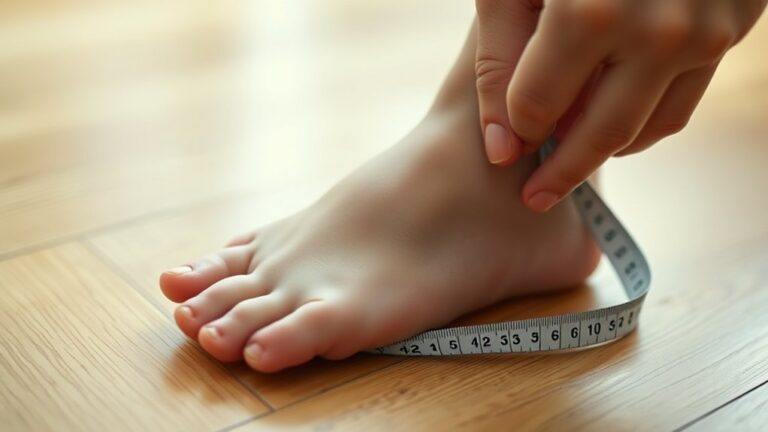
Although it might seem simple, measuring your foot correctly is key to finding the right European shoe size. For ideal sizing accuracy, stand upright and measure from your heel to the tip of your longest toe. Use a soft, flexible tape measure to follow the natural curve of your foot, ensuring precise results.
Measuring your foot upright from heel to longest toe with a flexible tape ensures accurate European shoe sizing.
It’s best to measure at the end of the day when your feet are slightly swollen, capturing their largest size. Record the length in centimeters since European sizes rely on metric measurements.
Don’t forget to measure both feet and use the larger measurement when selecting footwear.
This careful approach guarantees a proper footwear fit, preventing discomfort and ensuring your shoes feel just right from the start. Taking the time to measure properly really pays off!
How US, UK, and European Shoe Sizes Differ
You’ll notice that US, UK, and European shoe sizes all use different systems, so they don’t match up one-to-one. For example, US and UK sizes often differ by about one size.
On the other hand, European sizes are based on the actual foot length in centimeters and use a unisex scale.
Knowing these key differences really helps when you’re trying to pick the right fit, especially since there are variations depending on gender and age.
Key Size System Differences
How do shoe sizes differ across the US, UK, and European systems? Each system measures foot length differently, which affects how you pick shoes. This is especially important if you consider shoe material and foot arch support.
US sizes use inches, and women’s sizes are about two sizes larger than men’s for the same foot length. UK sizes are roughly one size smaller than US sizes. The European system uses centimeters and Paris points (⅔ cm), offering precise and unisex sizing.
| System | Measurement Unit | Size Difference Compared to US | Notes |
|---|---|---|---|
| US | Inches | Base size | Gender-specific |
| UK | Inches | ~1 size smaller | Gender-specific |
| European | Centimeters | Varies | Unisex, uses Paris points |
Knowing these differences helps you find the right fit for your foot arch and shoe material needs. It makes shoe shopping a lot easier and more comfortable.
Gender And Age Variations
Understanding the differences in shoe sizing systems isn’t complete without considering gender and age variations, especially in US and UK sizes.
US and UK systems have distinct gender differences. For example, a US women’s size 9 converts to EU 40-41, while a men’s size 9 matches EU 42-43.
UK sizes are typically about one size smaller than US sizes for the same foot length. This reflects regional standards and shoe last designs.
On the other hand, European sizes use a unisex system based solely on foot length in centimeters, so they avoid gender-based variations.
Age variations also come into play, as children’s sizes differ markedly from adult ones in US and UK systems. This means you need to be careful when converting.
Knowing these gender differences and age variations helps you find the right European size smoothly.
Metric And Numbering Basics
Although shoe sizes might seem straightforward, the metrics and numbering systems behind US, UK, and European sizes differ considerably. These variations stem from historical sizing standards and regional measurement differences.
The US system uses foot length in inches, while the UK scale is about one size smaller for the same foot. UK sizes run smaller, with a distinct numbering scale.
European sizes rely on a metric system, measuring foot length in centimeters, and apply a unisex scale. European sizes range from 35 to 50, each step about 0.67 cm.
Conversion requires charts due to differing metrics and numbering. Understanding these basics helps you navigate sizing across regions accurately.
Converting US to European Shoe Sizes
Converting US shoe sizes to European ones usually means adding between 30 and 34 to your US size, depending on whether you’re looking at men’s or women’s shoes.
To convert US shoe sizes to European, simply add 30 to 34 depending on gender.
For women, add about 30 or 31, so a US size 9 converts to EU 39 or 40.
Men’s sizes require adding 33 or 34, making a US 9 around EU 42 or 43.
Keep in mind, shoe material and color options might slightly influence fit across brands, so always check specific size charts when possible.
Knowing your exact foot length in centimeters helps guarantee accuracy.
By using these guidelines, you can confidently convert your US shoe size to European sizing for a better fit and style choice.
It’s pretty straightforward once you get the hang of it!
Women’s European Shoe Size Chart and Conversion Guide
When you shop for women’s shoes in Europe, knowing how to read the size chart can save you time and guarantee a perfect fit. European sizes range from 35 to 44, roughly matching US sizes 5 to 11.5. Each size reflects foot length in centimeters, increasing by about 0.5 to 1 cm, so accurate foot measurement is key to a comfortable shoe fit.
For example, EU size 38 equals US 7.5, and size 40 matches US 9.
To use the women’s European shoe size chart effectively, keep these points in mind:
- Measure your foot length precisely in centimeters
- Compare your measurement to the EU size scale
- Remember EU sizes increase incrementally by 0.5 to 1 cm
- Use the chart to convert US sizes easily to EU
This guide ensures a reliable shoe fit when shopping internationally. Just follow these steps, and you’ll find the perfect pair without any hassle.
Men’s European Shoe Size Chart and Conversion Guide
If you’re switching from US to European men’s shoe sizes, just add about 33 or 34 to your US size for a rough conversion. It’s a simple way to get started.
Keep in mind, though, that EU sizes are based on foot length in centimeters and usually go up by around 0.7 to 1 cm per size.
So, sizes can feel a bit different depending on the brand.
That’s why it’s always a good idea to check a detailed size chart. It helps make sure you get the best fit possible since shoe sizing isn’t always one-size-fits-all.
Men’s US to EU
Understanding how to convert men’s US shoe sizes to European sizes is essential for finding the right fit when shopping internationally. Typically, you add about 33 or 34 to your US size to get the EU equivalent, though this varies by brand.
For instance, a US size 10 usually corresponds to an EU size 44 or 45.
Keep in mind, European sizes measure foot length in centimeters, increasing roughly 0.7 to 1.0 cm per size. When selecting shoes, consider shoe material and your foot arch, as these affect comfort and fit beyond just size.
US sizes range from 6.5 to 15.5. EU sizes range from 39 to 50.5. Sizing varies by manufacturer. Foot arch support plays a key role in fit quality.
Size Conversion Tips
Converting your US shoe size to a European size is easier when you use a reliable size chart that matches foot length in centimeters to EU sizes.
Since European sizes are based on foot length, measuring your foot in centimeters gives you the most accurate starting point.
Remember, adding about 33 or 34 to your US size usually works, but always confirm with a size chart.
Keep in mind, shoe material affects fit. Leather may stretch, while synthetic materials often don’t.
Also, fashion trends influence shoe shapes and sizing, so styles may fit differently year to year.
Because brand sizing can vary, consult specific brand guides alongside general charts to ensure the best fit.
This approach helps you pick the right European size confidently.
European Shoe Sizes for Kids and Babies
Although kids grow quickly, finding the right European shoe size for babies and children is simpler than you might think. European sizes for infants range from 12.0 to 21.5, fitting foot lengths between 7.5 and 13.5 cm. For kids, sizes run from 22.5 to 33.5, matching 14.2 to 21.0 cm feet.
Shoe manufacturing standards in Europe assure each size increases by about 0.7 to 1.0 cm, making sizing pretty predictable. When shopping, especially in footwear fashion, measure your child’s foot at the end of the day for accuracy. That way, you’ll get the best fit possible.
Remember, European sizes link closely to UK and US sizes, which really helps when you need to convert between them.
- Tiny toes wrapped in soft, flexible soles
- Growing feet sliding into snug, stylish designs
- Precise length measurements guiding choices
- Durable shoes crafted for active little steps
Common Shoe Size Conversion Issues and Solutions
When you shop for shoes across different regions, you’ll often find that the same European size can fit quite differently depending on the brand or manufacturer. Variations in shoe lasts, manufacturing processes, and even shoe material affect fit. Also, inaccurate foot measurements, like measuring while seated or without socks, can lead to wrong conversions.
Remember, relying solely on generic size charts without checking brand-specific notes increases errors. Shoe color can sometimes indicate different material types, which subtly affects fit too.
| Issue | Solution |
|---|---|
| Different brand sizing | Check brand-specific charts |
| Inaccurate foot measuring | Measure standing with socks |
| Relying on generic charts | Use detailed conversion guides |
| Material affects fit | Consider shoe material info |
| Color indicates material | Check color-related material info |
Tips for Choosing European Shoe Sizes Online
How can you guarantee your European shoe size fits perfectly when shopping online? Start by measuring your foot accurately in centimeters at the end of the day when your feet are most swollen. Check the specific brand’s size chart since European sizes can vary. Also, consider your foot arch and chosen shoe material, as these affect fit and comfort.
Keep these tips in mind:
- Use reliable conversion charts linking foot length in centimeters to European sizes.
- Read customer reviews to learn if sizes run true, small, or large.
- Order half sizes or width options if available for a better fit.
- Factor in shoe material flexibility and your foot arch shape for ideal comfort.
These steps help you pick the right European size online confidently. Just take your time, and you’ll be stepping out in shoes that fit just right!
Why Accurate Shoe Size Conversion Matters for Comfort
Getting your European shoe size right online is just the start. Understanding why accurate size conversion matters can make all the difference in comfort. If your size is off, even the best shoe material won’t prevent blisters or foot arch pain.
Proper sizing supports foot stability and reduces fatigue. This lets you stay comfortable all day. Plus, knowing exact size equivalents saves you from costly returns.
| Issue | Cause |
|---|---|
| Blisters | Incorrect size fit |
| Bunions | Tight shoe material |
| Fatigue | Poor foot arch support |
| Instability | Wrong size conversion |
| Returns/Exchanges | Sizing confusion |
Accurate conversions ensure your footwear fits perfectly. This enhances both comfort and foot health.
Frequently Asked Questions
How Do European Shoe Widths Compare to US Sizes?
European shoe widths vary with less sizing consistency than US sizes, which use clear width categories. You’ll find shoe width variations in Europe, but they’re less standardized.
Are European Shoe Sizes Unisex or Gender-Specific?
European shoe sizes offer sizing consistency and are generally unisex, so you won’t find strict gender distinctions.
That said, some brands might have specific fits or styles. It’s always a good idea to check their sizing guides before buying.
Better safe than sorry, right?
What Materials Are Commonly Used in European Shoes?
You’re stepping into a world where traditional craftsmanship meets nature’s finest threads. European shoes often blend sustainable materials like vegetable-tanned leather, recycled fabrics, wool, and cork. This creates durable, eco-friendly footwear that feels both timeless and fresh.
It’s a style that respects the environment without sacrificing quality or comfort. Plus, these materials age beautifully, telling a story with every wear. So, when you slip into a pair of European shoes, you’re not just wearing footwear — you’re embracing a tradition of care and sustainability.
How Often Does European Shoe Sizing Change Over Time?
You won’t see European shoe size standards change often because they prioritize sizing consistency. Updates happen rarely, mainly to improve accuracy or standardization.
Can European Shoe Sizes Vary by Country Within Europe?
You’ll notice up to a 0.5 size difference due to regional sizing and manufacturing standards. Countries like Italy and France follow slightly varied practices, so your European shoe size can indeed vary depending on where you shop.
It’s pretty common to find these small differences, especially when buying shoes from different European countries. So, if you’re ordering online or traveling, keep that in mind! It can save you some hassle with returns or exchanges.
Conclusion
Choosing the right European shoe size might seem tricky at first, but with accurate measurements and our conversion charts, you’ll avoid the guesswork. Even if you think sizes vary too much between brands, understanding the basics guarantees a better fit and greater comfort.
Remember, taking the time to convert correctly means fewer returns and happier feet. This makes shopping for European shoes online a breeze. Don’t let sizing confusion stop you from stepping in style and comfort.