What Shoe Size Is 40 In Us – Conversion Guide Explained
If you wear an EU size 40, your US size will typically be women’s 9 to 9.5 or men’s 7.5 to 8, depending on fit and brand. Measuring your foot length, usually around 25 cm, helps guarantee accuracy. Styles and materials can affect sizing, so it’s good to keep that in mind.
Remember, women’s shoes tend to be narrower, and men’s wider, so width matters too. Understanding these nuances makes picking the right pair easier. There are more tips to explore beyond just the numbers, which can really help when shopping.
Key Takeaways
- EU size 40 generally converts to US women’s size 9 to 9.5 and men’s size 7.5 to 8.
- A foot length of about 25 cm typically corresponds to EU size 40 and related US sizes.
- Women’s US sizes for EU 40 are narrower, while men’s US sizes are wider and differ by 1.5 to 2 sizes.
- Shoe material and width options significantly affect the fit when converting EU 40 to US sizes.
- Always measure both feet and consult brand-specific charts for accurate US size conversion from EU 40.
What EU Size 40 Converts to in US Men’s and Women’s Sizes
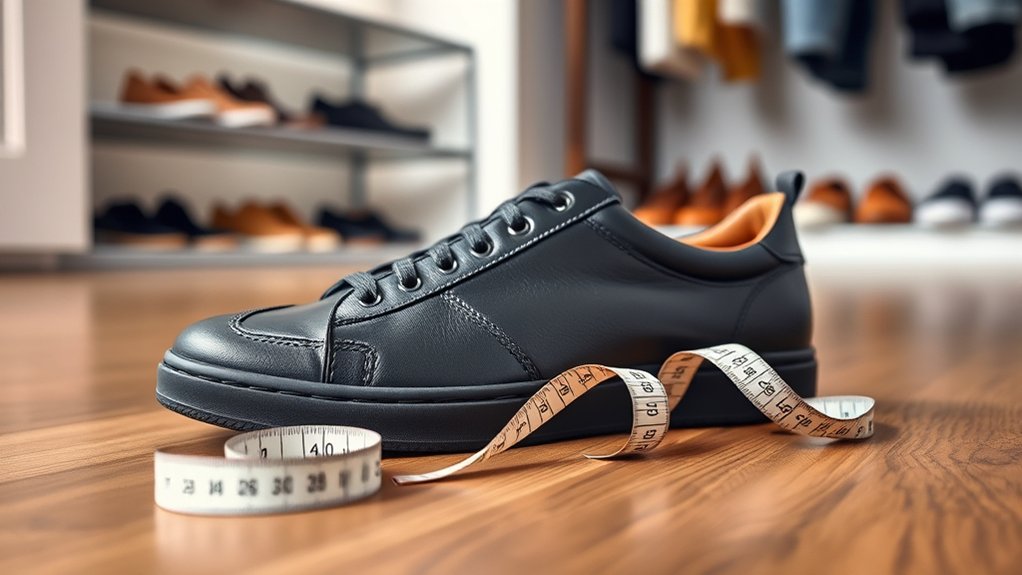
When you see an EU size 40, it typically converts to a US women’s size 9 to 9.5 or a US men’s size 7.5 to 8, depending on the brand and shoe style. This size corresponds to a foot length of about 25 centimeters, but slight variations occur due to fashion trends and material differences.
For example, sneakers made with flexible materials might fit differently than leather dress shoes, even in the same size. Because brands interpret sizing uniquely, a US women’s 9.5 from one label could feel like a 9 in another.
Staying aware of these nuances helps you choose shoes that fit well and suit your style. Always consider how current fashion trends influence shoe width and shape, impacting your overall comfort and fit.
How to Convert EU 40 to US Sizes Using Your Foot Length
How can you accurately convert an EU size 40 to US shoe sizes using your foot length? Start by measuring your foot length precisely. About 25 cm (9.84 inches) generally corresponds to EU 40.
Since international sizing varies, use these steps to navigate shoe size variability effectively. Measure your foot length in centimeters or inches for accuracy. Then, consult a reliable conversion chart that matches foot length to US sizes.
Typically, EU 40 converts to US women’s 9 or 9.5, and men’s 7.5 or 8.
Also, check specific brand sizing charts because shoe size variability can shift exact conversions. This way, you’ll get a better fit no matter the brand or style.
Understanding Gender Differences in US Shoe Sizes Compared to EU 40
When you convert an EU 40 to US sizes, you’ll see that women’s sizes usually run about 1.5 to 2 sizes larger than men’s for the same foot length.
It’s not just about the length, though. Women’s shoes tend to be narrower, while men’s are generally wider.
So, understanding these little differences can really help you find the right fit.
Keep in mind, EU 40 is a unisex measurement—it doesn’t take into account width or the specific design differences for men and women.
Women Vs Men Sizing
Although European shoe size 40 remains consistent across genders, understanding how it translates to US sizes requires attention to key differences between men’s and women’s sizing systems.
When converting EU 40 to US sizes, women’s shoes typically measure larger in US sizing than men’s. This reflects anatomical distinctions that affect shoe comfort and foot arch support.
Keep these points in mind:
- Women’s EU 40 usually equals US size 9, while men’s corresponds to about US size 7.5 to 8.
- Women’s shoes tend to be narrower, accommodating different foot arch shapes for ideal comfort.
- US sizing differs by about 1.5 to 2 sizes between genders for the same EU length, so precise conversion matters.
This knowledge helps you choose shoes that fit well and support your foot’s natural shape. It’s all about finding the right fit for your feet!
Width And Fit Differences
Because European size 40 corresponds to different US sizes for men and women, understanding width and fit variations becomes essential.
For men, EU 40 usually converts to US 7.5-8 with a wider fit.
Women’s US 9-9.5 shoes are narrower and shaped differently to accommodate foot volume.
European shoes generally run narrower overall, especially women’s styles. So, you’ll notice US sizes offer more width options, labeled B (narrow), D (standard), and E (wide).
When choosing shoes, consider how color options and material choices affect flexibility and fit. Leather may stretch, while synthetics hold shape.
Keep in mind that the same EU 40 can feel quite distinct between genders due to these width and volume differences. So always factor in your foot shape alongside length for the perfect fit.
How to Measure Your Foot to Find the Right US Shoe Size
How exactly can you guarantee your US shoe size fits perfectly? Start by measuring your feet accurately to ensure shoe comfort and proper support for your foot arch.
Follow these steps:
Stand barefoot on paper and trace your foot’s outline with a pencil. Then, measure the longest distance from the tip of your longest toe to your heel using a ruler or measuring tape.
Make sure to measure both feet because one may be larger. It’s best to base your size on the bigger foot.
Add about 0.5 to 1 cm (1/4 to 3/8 inch) to your measurement for a comfortable fit. Record your foot length in both inches and centimeters to match with US shoe size charts precisely.
This careful measurement helps you select shoes that support your foot arch and maximize shoe comfort.
Why Shoe Brands Can Affect Your EU 40 Size Conversion
When you convert an EU 40 to a US size, the fit can vary quite a bit depending on the shoe brand you pick. Each brand has its own manufacturing standards and uses different last shapes, which affect how the EU 40 matches up with US sizes.
Materials matter too. For example, leather might stretch over time, while synthetic materials usually stay rigid. This can change how comfortable the shoe feels and how well it fits.
Leather may stretch with wear, while synthetic shoes typically remain firm, impacting comfort and fit.
Some brands run narrower or wider than others. So even if the label says EU 40, the actual fit might feel very different. To get the best fit, it’s a good idea to check brand-specific size charts and read customer reviews.
If you don’t consider these things, you might end up with a US size that doesn’t really suit your foot, even though it matches the EU 40 label.
Half Sizes and Width Differences When Converting EU 40 Shoes
Understanding brand variations in shoe sizing sets the stage for recognizing the impact of half sizes and width differences when converting an EU 40. Since EU 40 often equates to US women’s 9 or 9.5 and men’s 7.5 or 8, half sizes play a vital role in achieving a perfect fit.
Width differences matter too, as European shoes tend to be narrower than US counterparts.
When choosing EU 40 shoes, consider these factors influenced by shoe material and fashion trends. Half sizes in US sizing can provide a better fit, especially if your feet are slightly wider or narrower.
European shoe designs often prioritize sleek, narrow profiles, which are affected by popular fashion trends.
Also, look for wide-specific options if shoe material is less forgiving or rigid. This awareness helps you avoid discomfort and guarantees style without compromise.
Tips for Buying EU 40 Shoes in the US
Finding the right fit for EU 40 shoes in the US requires careful attention to sizing variations and brand-specific measurements. Since EU 40 generally converts to a US women’s 9 or men’s 7.5 to 8.5, you should always check the brand’s size chart for sizing consistency.
Measure your foot accurately and compare it to the brand’s guidelines to avoid guesswork.
Pay attention to shoe material, as it influences stretch and comfort. Leather may mold to your foot, while synthetic materials might not.
Width and construction also impact fit, so read reviews for insights on particular styles.
When possible, try shoes on in-store or order multiple sizes online to find the best US equivalent. This approach helps guarantee comfort and prevents returns due to size mismatches.
It’s all about finding what works best for your feet!
Frequently Asked Questions
Are EU 40 Shoes Typically Wider or Narrower Than US Size 9?
EU 40 shoes are typically narrower than US size 9. So, if you care about shoe width and size consistency, you’ll notice European sizes run slimmer.
On the other hand, US sizes tend to accommodate wider feet with more consistent width options. This difference can make a big impact when you’re choosing shoes, especially if you have wider feet.
It’s something to keep in mind when shopping between European and US sizes. Shoes might fit lengthwise but feel different in width.
Can EU 40 Shoe Size Fit Children or Only Adults?
You generally won’t find EU 40 shoe size fitting children since European sizing targets adults here. With shoe size conversion, EU 40 aligns with US adult sizes, making it too large for most kids’ feet comfortably.
How Do EU 40 Shoe Sizes Vary by Shoe Type, Like Sneakers or Boots?
Imagine slipping into EU 40 sneakers that flex easily, offering wider shoe width. Boots, on the other hand, feel snugger with firmer shoe material.
You’ll notice dress shoes often have narrower width, so they demand careful fit checks. It’s all about finding what feels right for your feet!
What Materials Are Best for EU 40 Shoes to Ensure Comfort?
You should choose breathable mesh, genuine leather, and stretchable fabrics for EU 40 shoes. These materials, combined with memory foam insoles, guarantee comfort. Plus, prioritizing material durability enhances shoe manufacturing quality and long-term wear.
When you pick the right materials, your shoes not only feel great but also last longer. So, focusing on both comfort and durability is definitely the way to go.
Are There Regional Differences in EU 40 Shoe Sizing Within EUrope?
Yes, you’ll find regional sizing consistency varies despite European size standards. Different countries produce EU 40 shoes with subtle length and width differences, so don’t expect perfect uniformity.
But these variations are usually minor and manageable when trying shoes. It’s nothing to worry about too much! Just keep in mind that a size 40 might feel slightly different depending on where the shoes come from.
Conclusion
Now that you’ve cracked the code on converting EU 40 to US sizes, you’re well-equipped to step confidently into your perfect fit. Remember, shoe sizing isn’t one size fits all. Brands and gender differences can throw curveballs.
Measuring your foot accurately is your secret weapon. With these tips, you’ll avoid the guessing game and find shoes that fit like they were made just for you. Consider this your sole mate guide to smart shoe shopping!